Showing posts with label mohr's method. Show all posts

Monday, February 27, 2023

Mohr’s method indicator

Chromate ions (CrO42-) are typically used as the indicator in Mohr’s titration, which argentometrically determines the bromide, chloride, and cyanide ions by giving a red-brown color at the endpoint.

Precipitation titration is a type of titration that involves the formation of a precipitate during the titration process. Based on the application type and endpoint detection technique precipitation titration is classified into three methods, Mohr, Volhard, and Fajan's method.

Precipitation titration is based on chemical reactions that yield ionic compounds of limited solubility. Silver nitrate (AgNO3) is often considered the most important precipitating reagent. Titration methods that are based on the use of silver nitrate are commonly referred to as argentometric methods.

Which indicator is used in the Mohr method?

Potassium chromate can be used as an indicator for the argentometric detection of chloride, bromide, and cyanide ions that react with silver ions to produce a brick-red silver chromate precipitate in the region of the equivalence point.

When determining the concentration of chloride ions in a solution containing a silver nitrate standard, the Mohr method employs the use of chromate ions as indicators. Once all the chloride has precipitated as white silver chloride, the first excess of titrant will form a silver chromate precipitate, indicating that the process has reached its endpoint.

The following are the reactions:
Ag+ Cl- ↔ AgCl(s)

2Ag + CrO42-↔ Ag2CrO4 (s)

The amount of chloride in an unknown sample can be calculated by knowing the stoichiometry and moles consumed at the endpoint. The test determines the concentration of chloride in a solid sample.

List of indicators:

Method

Name of indicator

Endpoint color

Mohr's titration

Potassium chromate (K2CrO4)

Red-silver chromate

Volhard’s titration

Ferric ion (Fe3+)

Red-brown

Fajan’s titration

Dye Dichlorofluorescein (C20H10Cl2O5)

Green suspension turn pink


Commonly asked questions on the Mohr’s indicator are as follows.

Why is potassium chromate used as an indicator in the Mohr method?

The silver ions react with chromate ions when the potassium chromate (K2CrO4) is used as an indicator after the chloride ion has been extinction and when the solubility product of silver chromate is exceeded, a reddish-brown precipitate starts to form.

What solution is used in the Mohr method?

The Mohr method is a kind of precipitation titration in which the concentration of chloride ions in a given solution is measured by titrating it with a solution of silver nitrate.

What is used as a standard solution in Mohr’s method of titration?

The silver nitrate (AgNO3) solution is used as a standard in the titration of Mohr’s method.

What is the color in Mohr's method?

In Mohr's method, once all the chloride ions have interacted, red silver chromate is formed.

Why is it called Mohr's method?

German chemist Karl Friedrich Mohr was given the method. Thus, this process is known as Mohr's method. It is a method of direct titration.


Keywords:

Titrant, principle, medium, acid, analysis, ferric acetate, volumetric, compound, potassium thiocyanate (KSCN), potassium chloride (KCl), sodium chloride(NaCl) chemistry, class, and students, etc.
Monday, May 23, 2022

Precipitation titration: Principle, Example, Types, Indicators, Applications, and Importance

Learn about the principle, types, and applications of precipitation titration, which involves the formation of precipitate during the titration technique.

Chemical analysis plays an important role in the study of the composition of substances or materials. It is broadly divided into two types qualitative and quantitative analysis. Titration is also known as titrimetry or volumetric analysis. 

It is an analytical technique used to estimate the concentration of an analyte in a sample solution that is widely used in chemistry laboratories since it offers several applications and advantages.

Titration is carried out by using a burette containing a titrant with known concentration is placed above the conical flask or beaker of a solute. The titrant is added until the reaction is complete; the endpoint or equivalence point is usually indicated with an indicator. 

There are many different forms of titration such as acid-base titrations, redox titrations (oxidation-reduction), precipitation titrations, and complexometric titrations, in which each type involves a different type of chemical reaction.


What is precipitation titration with example?

Precipitation titration is a type of titration that involves the formation of a precipitate during the titration process. Precipitation titration refers to volumetric methods based on the formation of a slightly soluble precipitate, whereas the precipitating titration based on the use of silver nitrate (AgNO3) as a precipitating agent is known as the argentometric method.
Principle and types of precipitation titration

In a precipitate titration, the titrant reacts with the solute to produce an insoluble substance (precipitate). It continues until all of the solutes have been consumed in which uses silver ions to determine chloride levels. 

It is an important technique for determining halogens and certain metal ions. Precipitation titration is an important topic for class 12.

Precipitation titration example:

To estimate the chloride ion concentration in a sample solution, we can titrate it with a known concentration of silver nitrate solution.
The following chemical reaction takes place:
Ag+(aq) + Cl–(aq)→ AgCl(s).
  • During the titration, AgCl settles to the bottom of the conical flask in the form of a white precipitate.
  • The amount of silver ion used to reach the equivalence point is the same as the amount of chloride ion present at the start. The amount of silver ion used for the equivalence point is the same as the amount of chloride ion originally there.
  • Use n = cV to calculate the number of moles of silver or chloride ion.

What is the principle of precipitation titration?

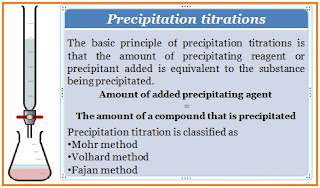
The basic principle of precipitation titrations is that the amount of precipitating reagent or precipitant added is equivalent to the substance being precipitated.

Amount of added precipitating agent = the amount of a compound that is precipitated

Precipitation titration curves:

The change in concentration of either a titrant or a titrand as a function of the titrant's volume is followed by a precipitation titration curve.
  • The precipitation titration curves are represented by:
  • During titration, the concentration of reactants changes
  • When using the indicators, there is a chance of titration error
  • The conditions at the equivalent point

Indicators used in precipitation titration:

For precipitation titration, there are three types of indicators are used, two of them are used chloride ions, while one is used cation silver.
  • In Mohr's titration, silver nitrate, or potassium chromate can use as an indicator to determine the concentration of chloride, which produces red silver chromate.
  • In Volhard’s titration, the ferric ion can use as an indicator to determine the silver ions, which produces red-brown color.
  • In Fajan’s titration, the dye dichlorofluorescein can use as an indicator to the determination of chloride, the endpoint being identified by the green suspension turning pink.

Determination of endpoint in precipitation titrations:

Ag+ titrations are known as argentometric titrations. To identification of endpoint in argentometric titration, three traditional methods based on color indicators can be used.
  • In Mohr's titration, the formation of colored precipitate at the endpoint
  • In Volhard’s titration, the formation of a soluble, colored complex at the endpoint
  • In Fajan’s titration, adsorption of a colored indicator on the precipitate at the endpoint

Types of precipitation titration:

There are three types of precipitation titration. According to the type of application and endpoint detection method, precipitation titration is classified as the Mohr method, Volhard method, and Fajan method.

Mohr method:

It is a type of precipitation titration used to determine the chlorides by titration with silver nitrate. It uses chromate ions (CrO42-) as the indicator, for the argentometric determination of bromide, cyanide and, chloride ions.

Volhard method:

The Volhard method is a type of precipitation titration to determine the bromine, chlorine, and iodine in the halide by precipitating it with excess silver nitrate and titrating the excess by addition with standard potassium thiocyanate (KSCN). It is performed in an acidic solution.

Fajan method:

It is a type of precipitation titration in which the reaction between the produced precipitate and the predictor is used in this method. Dichlorofluorescein is used as an indicator that acts as an anion in the solution.

Applications of precipitation titration:

  • Precipitation titration is most commonly applied for reactions where the titration cannot be recognized by changing the color.
  • The determination of halide ions or silver content using a sodium chloride (NaCl) solution is a typical use of precipitation titration.
  • The concentration of ions in the analyte sample can be determined using this method.
  • It is used to determine the salt content in water, food, and drinks, etc.
  • It has pharmaceutical applications also, such as analysis of carbromal, infusion of sodium chloride (NaCl), and potassium chloride (KCl) infusion, etc.

What is the importance of precipitation titration?

Precipitation titration is an important method in chemistry as it allows for an accurate determination of halogens and some metal ions concentration in the sample solution.


Sunday, August 29, 2021

Preparation and standardization of 0.1 M silver nitrate

    Learn about the preparation and standardization of silver nitrate through a laboratory experiment or practical.

Aim:

To prepare and standardize 0.1 M AgNO3 using sodium chloride as primary standard (Mohr’s method).

Requirements:

Glasswares: Burette, burette stand, conical flask, volumetric pipette, beaker, volumetric flask, funnel, glass rod, and wash bottle, etc.
Chemicals: LR grade silver nitrate (AgNO3), sodium chloride (NaCl), and potassium chromate (K2CrO4), etc.
Apparatus: Digital/analytical balance, and Ultrasonicator.

Principle:

Prepare and standardize silver nitrate-based on argentometric titration. When silver nitrate is directly titrated against sodium chloride, it forms a white precipitate AgNO3 with NaCl. When all of the NaCl has been consumed, it reacts with K2CrO4 and the endpoint is detected as a brick red color due to the formation of silver chromate and potassium nitrate.
The following is the reaction that is involved in this titration.
preparation and standardization of silver nitrate

The molecular weight of silver nitrate (AgNO3) is 169.87 g/mol.

Preparation of 0.1 M silver nitrate:

Take 16.99 gm of silver nitrate using a pipette, dissolve in 500 ml of distilled water in a volumetric flask, and properly mixing it. Once it has completely dissolved, make up the volume to 1000 ml.

Preparation of 0.1 M sodium chloride:

Take 05.84 gm of previously dried sodium chloride and dissolve in 500 ml of distilled water in a volumetric flask, and properly mixing it. Once it has completely dissolved, make up the volume to 1000 ml.

Preparation of 5% w/v potassium chromate solution:

Take 05.00 gm of potassium chromate and dissolve in 70 ml of distilled water in a volumetric flask, and properly mixing it. Once it has completely dissolved, make up the volume to 100 ml.

Titration procedure:

  • All glassware should be cleaned and dried according to standard laboratory procedures.
  • Before filling the burette for the titration, rinse it with distilled water and then pre-rinse it with a portion of the titrant solution. Pre-rinsing is required to make sure that all solution in the burette is the desired solution, not a contaminated or diluted solution.
  • Take the unknown stock solution of titrant in a clean and dry beaker then fill the burette using the funnel.
  • Remove air bubbles from the burette and adjust the reading to zero.
  • Take 25.00 ml of prepared solution of sodium chloride and pour it into a conical flask.
  • Add 2-4 drops of potassium chromate solution as an indicator.
  • Titrate the sample solution with silver nitrate solution until the endpoint is reached.
  • The actual endpoint of the titration is indicated by a brick red color at the end of the reaction.
  • To get accurate results, repeat the titration three times.
  • Properly record the readings of the burette.
  • Take their mean and calculate the molarity of the silver nitrate solution.


Observation table:


Sr. No.

Content in conical flask

Burette reading

Volume of titrant used (ml)

Initial

Final

1


2


3


Mean:


Calculations:

M1 V1= M2 V2,
M2 = V1 M1 / V2

Where,
M2 is the molarity of silver nitrate.
V1 is a volume of sodium chloride solution used
M1 is molarity of sodium chloride solution
V2 is a volume of silver nitrate used

Result:

The strength of the prepared silver nitrate solution was found to be_____M.


Commonly asked questions on titration are as follows.

Which indicator is used in the standardization of silver nitrate?
Standardization of silver nitrate is based on the argentometric titration in which potassium chromate solution is used as an indicator that produces a brick red color at the end of the reaction.

Why do we standardize the AgNO3 solution?
Standardization of a prepared silver nitrate solution is performed to determine its exact molarity.

Why should standard silver nitrate be protected from light?
Silver nitrate is protected from light due to it is extremely light-sensitive. This means that when the chemical is exposed to light, it will react. As a result, if this is exposed to direct sunlight or other bright light, it will begin to hydrolyze.


Thursday, August 12, 2021

Difference between Mohr method and Volhard method

The major difference between the Mohr and Volhard method is that the Mohr method involves the reaction of silver ions with halide ions in the presence of a chromate indicator, whereas the Volhard method involves the reaction of excess silver ions with halide ions.

Titration, often known as titrimetry, is a volumetric analysis used to determine the amount of analyte in a sample solution. This involves a titrant that is filled in the burette, a pipette used to introduce the analyte into the conical flask, where the reaction takes place. The titrant of known concentration is added until the reaction is completed (Chemical equivalence point). The endpoint of the titration is the point at which the reaction completes.

To detect the endpoint, an indicator is used that changes color at the endpoint. Alternatively, an instrumental method such as a pH meter, potentiometer, or conductivity meter is also used. There are four types of titrations based on the chemical reaction that occurs between the titrant and the solute, such as acid-base titration, redox titration, complexometric titration, and precipitation titration.

What is precipitation titration?

Precipitation titration is a type of titration in which the formation of a precipitate during the titration process is involved. Precipitation titration refers to the volumetric method that depends on the formation of a slightly soluble precipitate, while argentometric titration refers to precipitation titration using silver nitrate (AgNO3) as the precipitating agent.

Quantity of added precipitating reagent = amount of analyte being precipitated is the principle of precipitation titration. The titrant reacts with a compound to form an insoluble substance called a precipitate. This continues until all compounds have been consumed with silver ions being used to determine chloride levels.

The Mohr, Volhard, and Fajans method are types of precipitation titration are important analytical techniques used to determine the concentration of halide and certain metal ions. These methods are named after the scientists who developed this method.

What is Mohr’s method?

The Mohr method is a type of precipitation titration first described by a German chemist, Karl Friedrich Mohr. It is a direct titration method used to determine the chlorides by titration with silver nitrate.

It uses the chromate ions (CrO42-) as an indicator for the argentometric determination of bromide, cyanide, and chloride ions.

The Mohr method is more effective in the PH range of 06.00 to 09.00, above this pH range, the silver will precipitate with hydroxide. When all of the chloride ions have been consumed by the silver ion, a reddish-brown colored precipitate is formed as a result of the reaction between the silver ion and the chromate ion.

What is the Volhard's method?

The Volhard method is a type of precipitation titration and an example of back titration, first described by a German chemist, Jacob Volhard in 1874. It is used to determine the halide concentration using a back titration, which involves titrating chloride solution with silver ions and then determining the excess silver ion content in the sample.

The indicator in this experiment is a solution containing ferric ions, which can produce a red color with thiocyanate ions. A thiocyanate ion solution is used to titrate the excess amount of silver ions. In this case, the thiocyanate reacts with silver ions rather than ferric ions. The thiocyanate, on the other hand, will react with ferric ions after all of the silver ions have been used. Because ferric ions form ferric hydroxide in the presence of a basic medium, it needs to keep the solution acidic.

Difference between Mohr method and Volhard method:

  • In Mohr's titration, silver nitrate is used as the titrant and chloride ion solution as the analyte, while in the Volhard method, excess silver nitrate is used to precipitate chlorides, which is then titrated with potassium or sodium thiocyanate.
  • Mohr method is a direct method of titration, whereas the Volhard method is an indirect method of titration.
  • In Mohr's titration, at the endpoint, a colored precipitate is formed, whereas in Volhard's titration, at the endpoint a soluble, colored complex is formed.
  • Potassium chromate is used as an indicator in the Mohr technique, while ferric ammonium sulfate is used as an indicator in the Volhard method.
  • The Mohr method requires neutral or alkaline conditions, while the Volhard method requires acidic conditions.
  • The Mohr titration is performed at room temperature, while the Volhard titration is performed at temperatures below 20 degrees Celsius.
  • Iodine and cyanate cannot be titrated with the Mohr method, while iodide, bromide, and chloride can be determined with the Volhard method.
Mohr vs Volhard method
Difference between Mohr method and Volhard method


Commonly asked questions on titration are as follows.

What is the Fajan method? 
Fajan's method is a type of precipitation titration in which silver ions are titrated with halide or thiocyanate ions in the presence of an adsorption indicator. Dichlorofluorescein is a solution-based indicator used in the Fajan method that is an anion in the solution.

What is the basic difference between the Volhard method and the modified Volhard method?
The major difference between Volhard and the modified Volhard method is that the Volhard method is used to determine the chlorine, bromine, and iodine in the form of halides, whereas the modified Volhard method is used to determine the anions that precipitate with silver.

What is the advantage of the Mohr method?
The Mohr method has the advantage of being a simple, precise, and direct method for determining chloride concentration.