Tuesday, February 7, 2023

Applications of complexometric titrations

Complexometric titrations are specifically used to determine the mixtures of different metal ions in solution. The endpoint of the titration is usually identified using an indicator that causes a color change.

Titration is a specific laboratory method for determining the concentration of an unknown analyte, based on the goals and procedures it has 4 types, acid-base, redox, precipitation, and complexometric titration.

Complexometric titration, which is also called chelatometry, is a method of volumetric analysis in which a colored complex is used to detect the endpoint of the reaction. It is performed using a chelating agent, such as ethylenediaminetetraacetic acid (EDTA).

The EDTA reacts with the metal ions in the sample to form complexes, which can then be titrated with standard acid. Measuring the endpoint of the titration allows the concentration of the metal ion present in the sample to be determined.

Direct titration, back titration, replacement titration, and indirect titration methods are some of the numerous methods of complexometric titration.

Applications of complexometric titration:

  • The major application of complexometric titration is that it is used to measure the amount of metal ions present in sample solutions.
  • This method is used to determine the various complexes of magnesium and calcium that are present in water and which act as a hardening agent of water.
  • It is used to analyze urine and blood samples, etc, in the field of biological analysis.
  • It is possible to use complexometric titration to test for the presence of calcium, magnesium, and other metals in food products such as milk, orange juice, vegetables, etc.
  • In the pharmaceutical industry, complexometric titration is often used to determine the concentration of a metal present in a pharmaceutical dosage form (Drug).
  • In analytical chemistry, it is used in the process of performing assays.
  • Titanium dioxide content in cosmetic products can be determined through the use of complexometric titrations.
  • In the field of environmental analysis, complexometric titrations are used to determine bad metals.
  • Complexometric titrations can also be used to determine the concentration of a weak acid or a weak base in a solution. The weak acid or base concentration can then be determined by measuring the amount of strong acid or base used in the titration.


People also ask:

What is the principle of complexometric titration with EDTA?
Example of complexometric titration
Importance of complexometric titration
What is the importance of complexometric titration in pharmaceutical industry?
What is the importance of pH in complexometric titration?
What are the uses of EDTA indicator?


Monday, February 6, 2023

Redox indicator: Theory, Mechanism, Types, Use, Example, List

Learn about the characteristics, mechanism, examples, and types of redox indicators that are used to detect the endpoint of redox reactions by different ways such as self indicators, redox indicators, external indicators, and instrumental techniques, etc.

Titration, also known as titration, is a volumetric analysis used to determine the concentration of an analyte in a sample solution in the presence of an indicator. Based on the reaction and the goals there are four types of titration: acid-base, complexometric, redox, and precipitation.

A solute is titrated by placing a burette containing a titrant with a known concentration over a conical flask or beaker containing the solute. Titrant is added until the reaction is complete; typically, an indicator indicates an endpoint or an equivalence point of the reaction.

What is redox titration?

Redox titration is a method used in the laboratory to determine the concentration of an analyte by carrying out a redox reaction between the analyte and the titrant. Redox titration depends on the oxidation-reduction reaction that occurs between the analyte and the titrant.

In order to evaluating the redox titrations, it is necessary to obtain the shape of the titration curve that corresponds. In this type of titration, it is much easier to monitoring the concentration of the reaction potential rather than the concentration of the reacting species.

Depending on the titrant used, there are different types of redox titration, such as bromatometry, cerimetry, permanganometry, iodometry or iodimetry, dichrometry, etc., and depending on the method it is classified as direct titration, and back titration.

What is redox indicator in chemistry?

An indicator that exhibits a definite color change at a specific electrode potential is referred to as a redox indicator. Due to the need for a rapid and reversible change in color, the oxidation-reduction equilibrium of an indicator redox system needs to be established very rapidly.

Redox indicators are organic molecules can be either oxidized or reduced, and their oxidized and reduced forms exhibit different colors.

In ox + ne ↔ In red

Example of redox indicator:

A good example of a redox indicator is 2, 2’-bipyridine, it is an organic compound with the formula C10H8N2 that changes color from pale blue to red when in solution at an electrode potential of 0.97 V.

Types of redox indicators:

There are two common types of redox indicators that are used in chemistry are metal complexes of phenanthroline and bipyridine, and organic redox systems.
  • In the systems of metal complexes of phenanthroline and bipyridine the metal changes oxidation state.
  • In the systems of organic redox (methylene blue) systems a proton participate in the redox reaction. Consequently, redox indicators can also be classified into groups of pH-independent or pH-dependent.
Some commonly used redox indicators are methylene blue, diphenylamine, Ferroin (1, 10- phenanthroline iron (II) sulphate, and nitro ferroin, etc.

Redox indicator

Characteristics of redox indicators:

The following are the general characteristics of good redox indicators.
  • In a redox titration, a redox indicator should show that the oxidation potential changes rapidly near the equivalence point.
  • In a redox titration, a redox indicator should characterize the rapid change in oxidation potential near the equivalence point.
  • The ideal redox indicator has an oxidation intermediate midway among the solution titrating and the titrant that need to be produce a sharp, easily noticeable color change.
  • When we carry out the redox reaction, both the oxidation and reduction processes need to be quick and reversible.
  • When operating a specific potential range, each redox indicator will change color.
  • The indicator's standard potential must be at least 0.15V different from the redox system's for a sharp color change at the endpoint.

Mechanism of redox indicator:

Diphenylamine was one of the first redox indicators that were commonly used in titrimetric analysis. Since this molecule is not readily soluble in water and tungstate ion and mercury (II) chloride interfere with its activity, the barium or sodium salt of diphenylamine sulfonic acid is utilized more frequently. 

This indicator is available in both reduced and oxidized forms, with the latter having a dark violet color. Using diphenylamine as an example, it has been shown that the mechanism underlying the color shift is as follows:

The diphenylamine solution in concentrated sulphuric acid (H2SO4) is colorless. It is used while titrating Fe (II) in a solution of potassium dichromate (K2Cr2O7). It is initially converted to colorless diphenyl benzidine by an oxidizing agent. This is then further reversibly oxidized to produce diphenyl benzidine violet.

If diphenyl benzidine violet is let to in an excess of dichromate solution, it will oxidize further. The subsequent oxidation is irreversible, and red or yellow compounds of unknown composition are formed.

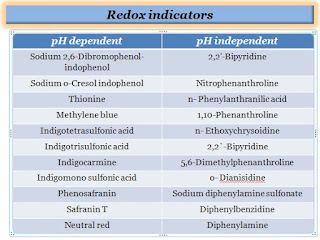
List of redox indicators:


pH dependent pH independent
Sodium 2,6-Dibromophenol-indophenol (+0.64 V/+0.22 V) 2,2'-Bipyridine (+1.33 V)
Sodium o-Cresol indophenol (+0.62 V/+0.19 V) Nitrophenanthroline (+1.25 V)
Thionine (+0.56 V/+0.06 V) n- Phenylanthranilic acid (+1.08 V)
Methylene blue (+0.53 V/+0.01 V) 1,10-Phenanthroline (+1.06 V)
Indigotetrasulfonic acid (+0.37 V/-0.05 V) n- Ethoxychrysoidine (+1.00 V)
Indigotrisulfonic acid (+0.33 V/-0.08 V) 2,2`-Bipyridine (+0.97 V)
Indigocarmine ( +0.29 V/-0.13 V) 5,6-Dimethylphenanthroline (+0.97 V)
Indigomono sulfonic acid (+0.26 V/-0.16 V) o- Dianisidine (+0.85 V)
Phenosafranin (+0.28 V/-0.25 V) Sodium diphenylamine sulfonate (+0.84 V)
Safranin T (+0.24 V/-0.29 V) Diphenylbenzidine (+0.76 V)
Neutral red (+0.24 V/-0.33 V) Diphenylamine (+0.76 V)


References:
  • ‘What Is a Redox Indicator in Chemistry?’ ThoughtCo, Available Here: 
  • ‘Redox Indicator’. Wikipedia, 8 Apr. 2022. Wikipedia, Available Here:
  • Redox Indicator - Wikidoc, Available Here
  • Sabnis, Ram W., et al. ‘Indicator Reagents’. Ullmann’s Encyclopedia of Industrial Chemistry, edited by Wiley-VCH Verlag GmbH & Co. KGaA, Wiley-VCH Verlag GmbH & Co. KGaA, 2009, p. a14_127.pub2. DOI.org (Crossref), Available Here:

Keywords:
Examples, internal, work, pharmaceutical analysis


Friday, February 3, 2023

Applications of gravimetric analysis

The major application of gravimetric analysis is that it is used to determine the mass or concentration of an analyte (substance) by measuring a change in mass.

A titration is a method for determining the concentration of an unknown solution using a solution of known concentration. Depending on the sample and purpose, this can be performed in a variety of ways, including acid-base titrations, precipitation titrations, complexometric titrations, and redox titrations.

What is gravimetric analysis?

Gravimetric analysis is a quantitative chemical analysis technique in which the desired element is converted into a material (of known composition) that can be separated and weighed. In analytical chemistry, it is a method of measuring analyte concentration based on the density of a solid. 

The determination of chloride present in a chemical is an example of gravimetric analysis. To perform a gravimetric analysis, you need to find a cation that forms an insoluble compound with chloride; It must be easily filtered and pure.

There are four different types of gravimetric analysis, including the precipitation method, the volatilization method, the electrogravimetry method, and the thermo-gravimetric method. Of these, two common types involve changing the phase of the analyte to separate it from the rest of a mixture, which causes a change in mass.

What are the applications of gravimetric analysis?

  • Gravimetric analysis is a quantitative technique for accurately determining the amount of a chemical by selectively precipitating the substance from an aqueous solution.
  • Gravimetric analysis has a wide range of applications, some of which include the chemical analysis of ores and other industrial materials, the calibration of various equipment, and the elemental analysis of inorganic compounds.
  • It is used in different industries to determine the chemical composition of rocks, minerals, and alloys, as well as to evaluate the quality of raw materials and finished goods.
  • It can easily give accurate and highly correct data, so it can be used to calibrate other instruments.
  • The ability to perform an incredibly precise analysis is one of the uses of gravity analysis. It determines the atomic masses of many elements in the periodic table.
  • Determining the volume of plasma is one of the applications of gravimetry in pharmacy and biology.
  • Another advantage of gravimetric analysis is that it helps reduce the number of errors made by instruments when measuring the mass of substances.

Commonly asked questions:

What are the steps involved in gravimetric analysis?
1- Sample preparation using a solution whose weight is known
2- Separation of the required constituent
3- Weighing of separate component
4- Calculating the quantity of a certain constituent in a sample based on the separated ingredient's measured mass.

How is a gravimetric analysis used in the laboratory?
Gravimetric analysis is a method that is used in laboratories to quantify the mass or concentration of a substance by using a change in mass.

Which equipment is essential for gravimetric analysis?
Gravimetric analysis often uses lab tools like bottles, beakers, crucible tongs, crucibles, and filter paper.


Keaywords:
Real life,  pharmacy, analytical chemistry, food industry, pharmaceutical industry, importance, use of gravimetric analysis in quality control.

Wednesday, January 25, 2023

Why pH Value is measured between 0 and 14?

The concentrations of the solutions in the lab are typically 1 M or less; therefore, we obtain no more than 1M hydrogen ions for pH 1, and for pH 14, we get no more than 1M hydroxide ions. The pH value, which ranges from 0 to 14, indicates the alkalinity and acidity of a solution.

pH is defined as the negative logarithm of the H+ ion (hydrogen ion) concentration. It is measured by the pH scale, which has a scale range of 0–14. A pH scale is used to measure acids and bases.

The mathematical definition of pH is simple; it states that pH is equal to the negative logarithm of the hydrogen ion (H+) concentration.
pH = -log [H+]
Solutions with a pH value between 0 and 7 on the pH scale are said to be acidic, and solutions with a pH value between 7 and 14 on the pH scale are said to be basic. Neutral solutions are those that have a pH of 7 on the pH scale.

The acidity or alkalinity of a solution can be measured by its pH using litmus paper (blue or red), pH paper, universal paper, indicator solutions, or more accurate electrochemical procedures employing electrodes and a pH meter (millivoltmeter).

Why does the pH range from 1 to 14?

Because the concentrations of the commonly used solutions in the pharmaceutical lab are normally 1 M or less, hence, we receive no more than 1M hydrogen ions for pH 1 and no more than 1M hydroxide ions for pH 14.

This is the most frequently asked question related to the pH scale by science/chemistry students in school/college. The pH scale doesn't range from 0 to 14. The pH values of common solutions fall within this range, although they may also be inside or outside this range.

This is supported by mathematical calculations employing equations that express the equilibrium constant and dissociation constant of the dissociation of water (H2O) into positive and negative hydrogen and hydroxide ions, respectively.

When the concentration of the solution exceeds 1M, the pH value leaves the range of 0 to 14. While in general, the pH value is the negative logarithm of the hydrogen ion concentration, chemistry graduates will know that technically, the value is a measure of hydrogen ion activity. Although this is difficult to estimate or detect experimentally, the former method is suitable for most cases with appreciable accuracy.

why is ph between 0 and 14

Summery:

  • The pH value of a solution is the negative base-10 log of the hydronium ion concentration of the solution.
  • We use solutions that typically have a concentration of 1 M or less. Therefore, at pH 1, we obtain only 1M hydrogen ions, while at pH 14, we obtain only 1M hydroxide ions.
  • Because pH is a logarithmic measure, a change in pH of one unit is equivalent to a ten-fold change in the concentration of hydrogen ions.


Commonly asked questions:

What does a pH level of 14 mean?
Any solution with a pH of 14 or higher is considered to be strongly alkaline.

Why does the pH level change?
If we add acid or base to the solution, the concentration of hydrogen ions increases or decreases, which causes a change in the pH level.

Why does pH change slowly at first?
Due to the logarithmic nature of the pH scale, meaning that a pH of 1 will have 10 times the hydronium ion concentration than a pH of 2, the pH rises slowly at first.

Why do pH papers contain only 1 to 14 no.?
Because it is a logarithmic scale, the pH scale ranges from 0 to 14 and is used to measure the acidity or alkalinity of a solution.


People also ask

Why is the pH scale inverse?
Why is neutral pH 7 and not 0?
Why does the pH scale start at 7?
Why ph range is 0 to 14? - quora
The ph scale ranges from 0 to 14 and is used to indicate the
Is the ph scale 1-14 or 0-14 only
Why the ph range is is from 0 to 14 for aqueous solutions
Can we have pH less than 0 or more than 14 Why or why not?
What is pH full form?


Monday, January 23, 2023

Advantages and disadvantages of healthy food

Healthy food is essential for human health, appearance and energy. This can help us reduce their chances of developing health problems. Healthy food is more beneficial for our health than junk food or fast food. 

If people make the right food choices and follow their diet consistently, it can be easy to maintain. There are several healthy food options available, and we should determine what works best for us.

What is healthy food?

Foods that are high in nutrition and benefit our overall health are called healthy foods. It offers a variety of organic food options, including natural foods, whole foods, and no processed food. Any food that is high in vitamins, fiber, minerals, carbohydrates, fats, proteins, water, and other nutrients can be considered healthy. 

Some examples of healthy foods are nuts, vegetables, fruits, milk or dairy products, peanuts, pecans, and walnut, etc.

Advantages of healthy food:

  • The major advantage of eating healthy food is that it contains high amounts of vitamins and minerals, which are essential for the human body to stay energized and avoid health problems. 
  • It provides the body with more energy and essential nutrients that it needs to function optimally.
  • Healthy foods contain antioxidants that help eliminate potentially damaging cells (Free radicals)
  • Like junk food and fast food, eating healthy (homemade) food we does not get addictive tendencies.
  • A healthy diet can reduce the chances of chronic health problems.
  • It helps in achieving and maintaining a healthy weight.
  • Eating a healthy diet rich in vegetables, fruits, whole grains and lean meats is an excellent way to maintain a healthy heart in general.
  • It helps the body function better.
  • It helps in keeping the digestive system functional and healthy.
  • Healthy food can boost your immune system and a strong immune system helps in keeping a person healthy.
  • It helps to regulate the blood sugar level in the body.
  • Healthy food contains vitamins and minerals that can improve the health of your hair, skin, and nails.
  • It can support brain development and keeps your mental health.
  • By eating healthy food, we can reduce the risk of heart disease, type 2 diabetes and some cancers.
  • It contains calcium, which is an essential mineral to build and maintain strong bones and teeth.
  • It supports healthy growth, body muscles, healthy pregnancies and breastfeeding.
  • It can help you sleep better, have more energy, and live longer.

Disadvantages of healthy food:

  • The major disadvantage of eating healthy food is that it can be expensive and take longer to prepare than junk or fast food. It is not possible for a person with little money to buy fresh fruits and vegetables regularly. Maintaining a healthy diet can be difficult over time.
  • People have a wide variety of healthy food choices, but it can be challenging to identify the ones that work best for their diet.
  • Since it is difficult to carry healthy food from home to work and other places, we depend on restaurants, or hotels, or street food. Therefore we become accustomed to dining outside.
  • Adapting to the changes brought about by healthy eating in our way of life can be very challenging. Some food cravings can be the result of long-term habits that are difficult to break.
  • Organic and chemical-free foods are becoming increasingly scarce in the market.
  • Healthy food like junk food may not always suit your taste buds, and this is the reason why people get bored after a while.
  • Healthy food does not have the same attractiveness, taste, variety, palatability and availability as junk food or fast food by which children’s or people attracted.
Advantages and disadvantages of healthy food


People also ask:

What are the negatives of healthy eating?
What are 3 challenges of eating healthy?
What are the advantages of healthy food?
10 disadvantages of healthy food
advantages and disadvantages of healthy food essay
advantages and disadvantages of healthy food and junk food
disadvantages of unhealthy food
what is healthy food
healthy food vs junk food 10 lines
advantages and disadvantages of junk food

Thursday, January 19, 2023

Conditions required for diazotization titrations

Diazotization titration, also known as nitrate titration, is a type of titration used in the pharmaceutical analysis that involves the conversion of primary aromatic amines into specific diazonium compounds. Peter Griffin first discovered the reaction mechanism for diazotization titration in 1853.

As per the reaction the primary aromatic group reacts with sodium nitrite (NaNO2) and a diazonium compound or diazonium salt will be formed. To prevent azo coupling, the diazotization reaction is carried out in acidic conditions (HCl solution).

Basic conditions required for diazotization titrations:

The following are some basic requirements that must be met for the diazotization titration to proceed:

The temperature of the reaction:

An ideal temperature is required for all reactions to take place. This ideal temperature can be increased or decreased to significantly slow (Rate) or stop the process. Similarly, diazonium compounds are unstable at high temperatures and decompose easily. 

This may cause adverse reactions and give the wrong result. Therefore, to avoid this problem, titration needs to be performed at low temperatures (0 to 5°C). Most amines form relatively stable diazo compounds at temperatures between 10–150 °C.

Rate of titration:

The rate of reaction differs depending on the compounds. The rate of reaction of amino compounds with HONO will also vary. Depending on their rate of conversion, we can classify them as either fast diazotisable or slow diazotized. 

Compounds with sulpha groups, nitrous oxide groups, and carboxylic groups are known as slow diazotisable compounds. Fast diazotisable compounds are those that solely include amino groups, or -CH3 or hydroxyl groups.


Diazotization Titration: Principle, Types, Applications

Learn the principle, theory, types, and applications of diazotization titration, which involves the conversion of an aromatic amine into diazonium compounds.

Titration is a method of chemical qualitative analysis used to determine the unknown concentration of an analyte. It is also known as titrimetry and volumetric analysis, in which an endpoint is determined by adding a known concentration of titrant to an unknown amount of analyte. Titration can be classified based on its procedures and goals, such as acid-base titration, precipitation titration, complexometric titration, and redox titration.

What is diazotization titration?

In pharmaceutical analysis, diazotization titration is a type of titration that involves the conversion of the primary aromatic amines into particular diazonium compounds. The reaction mechanism for diazotization titration was first discovered in 1853 by Peter Griessin.

According to his reactions, a diazonium compound or salt will be formed when the primary aromatic group reacts with sodium nitrite (NaNO2). Furthermore, the medium of this reaction is acidic.

Principle of diazotization titrations:

The basic principle behind diazotization titration is that, in the presence of an acid, the given sample of a primary aromatic amine will react with sodium nitrite (NaNO2) to yield a diazonium salt (for example, hydrochloric acid).

The chemical reaction of this process is as follows:

R-NH2+ NaNO2+ HCl→ R-N+≡ N-Cl–+ NaCl + H2O

Theory:

You will use sodium nitrite for the direct diazotization method in an acidic medium. it will release HNO2, and by measuring the volume of NaNO2 in the solution, we can easily analyze the number of primary amine groups that have free -NH2 groups.

The chemical reaction of this process is as follows:

NaNO2 + HCl →HONO + NaCl

ArNH2 + HONO + HCl →ArN2Cl + 2H2O

Using the starch paper test or an indicator, you can find the excess NaNO2 that is still present in the solution. Excess sodium nitrite (NaNO2) indicates that the reaction has reached its endpoint. The starch and I2 that are released at the end will react to produce a blue color. It is significant to note that it will only occur when an inorganic acid is present. Therefore, the following chemical reaction occurs to test it with starch iodide paper or solution:

KI + HCl →HI+ KCl

2HI +2HONO→ I2 +2NO +2H2O (excess)

I2 + Solution of paste of starch→ blue color (endpoint)

Types of diazotization titrations:

There are three different types of diazotization titration: direct method, indirect method, and other methods.

Direct Method:

The process consists of treating an amino group with an acidic solution, to yield the diazonium salts of the diazonium compounds. This solution will be stored in ice water to keep the temperature between 0 to 5°C. Then, titrate it with sodium nitrate and observe the endpoint.

Indirect method:

The indirect method of titration applies to insoluble diazonium salts. In this technique, you will need to add the excess nitrous acid into the sample titration solution. You need to titrate it against some other since it is an insoluble diazonium salt.

Other methods:

The other method consists of conversion into diazo oxides, which are typically more stable than diazo compounds.

Factors affecting diazotization titrations:

The following are some of the factors that affect diazotization titration:
  • The acid concentration used in titration
  • Time taken by the reaction
  • The efficiency of the attached diazotized group (rapid or slow)
  • The pH of sodium nitrite
  • Reaction temperature

Application of diazotization titrations:

  • The analysis of sulfonamides is the basic application of diazotization titration in pharmaceuticals.
  • It is used to determine the primary aromatic amine compound.
  • Diazotization titration is also used to determine the chlorophenol, alpha drug, procaine, etc.
  • It is commonly used in the dye and pigment industries.

Commonly asked questions on diazotization titrations are as follows.

What are the conditions required for diazotization titrations?
Maintaining the temperature of the reaction and rate of titration are the conditions required for diazotization titrations.

What indicator is used in diazotization titration?
Starch iodide paper is used as an indicator to indicate the endpoint of a reaction in diazotization titrations.

Why is HCl used in diazotization?
The diazotization reaction is conducted in the presence of excess HCl to avoid azo coupling.

What is the other name for diazotization titration?
Diazotization titration is also known as nitrite titration which is used in the analysis of aromatic compounds containing an amino group in the molecules.

What are the examples of slow and fast diazotized groups?
Nitrogen oxide, carboxylic groups, and sulpha, are examples of slow diazotized groups, and anilide, toluidine, and aminophenol are examples of fast diazotized groups.


Keaywords:
Applications, examples, principle, advantages and disadvantages


Friday, January 13, 2023

Applications of redox titration

Titration is a common laboratory technique for quantitative chemical analysis, to determine the concentration of a specific analyte/solute by comparing it with the known concentration of a solution in the presence of an indicator. 

Titration is classified into four different types based on goals and processes such as acid-base titration, redox titration, precipitation titration, and complexometric titration.

What is redox titration?

Redox titration is an analytical method to determine the concentration of sample analyte, redox reactions are oxidation-reduction chemical reactions in which the oxidation states of the reactants change. In which a redox indicator solution or potentiometer is used to determine the endpoint.

There are different types of redox titration depending on the titrant used, such as permanganometry, iodometry, bromatometry, iodimetry, cerimetry, and dichrometry, and based on the method are direct titration and back titration.

The reactions involved in redox titration are redox reactions in which electrons are transferred and oxidation states are changed. As a result, redox titrations are a useful way to learn more about the substances we come into contact with.

Concept of oxidation and reduction:

Oxidation:
It could be described as the loss of electrons to an oxidizing agent to produce a more positive or higher oxidation state.

Reduction:
It could be described as gain electrons from a reducing agent to produce a more negative or lower oxidation state.

Applications of redox titration:

Redox titrations have numerous applications in chemistry, industrial analyses, food industries, pharmaceutical preparations, agriculture, environmental analysis, and other fields. Its common example is the titration of sulfite in wine using iodine, as well as that of alcohol, which can be determined based on its oxidation by potassium dichromate (K2Cr2O7).
  • Industrial applications of redox titration:
Evaluation of chlorination of public water sources is one of the most important industrial applications of redox titration. As well as to determine the purity or content analysis of raw materials, oxidation-reduction reactions are also used.
  • Pharmaceutical applications of redox titration:
Redox titration is used in pharmaceutical analysis to measure the concentration of active pharmaceutical ingredients (concentration of iron) in pharmaceutical goods, such as tablets, capsules, and other medicinal products.
  • Applications of redox titration in chemistry:
Redox reaction is most commonly used to identify elements with medium and high concentrations. Many inorganic analytes can be analyzed using redox titrimetry. In inorganic analysis, it is used to determine the water content in a non-aqueous solvent using Karl Fischer reagent as a titrant. As well as dissolved oxygen can be a determination by this method.
  • Applications of redox titration in food:
The food industry makes broad use of an analytical method that enables it to estimate how much of a reactant is present in a sample. Redox titration can be used to measure the concentration of salt, sugar content as well as vitamin C, and E content present in a food product.

Some of the real-life applications and common applications of redox reactions are as follows.
  • It is used to purify metals.
  • It is used in environmental analysis for the determination of dissolved oxygen.
  • Redox reactions are used to manufacture a wide variety of chemicals, including chlorine and caustic soda.
  • Redox Reaction is used in combustion
  • Redox Reaction is used in electrochemistry
  • Redox Reaction is used in photosynthesis applications
  • Redox Reaction is used in photographic Films
  • Redox reactions are used in the electroplating process
  • Oxidation-reduction reactions are used to sanitize water and bleach materials.

Keywords:

Class 11 ncert pdf, medicine,  photosynthesis, pharmacy, potential, electrochemistry, everyday life, chemistry, dentistry, food, metallurgy, public health and environmental analyses.


Thursday, December 22, 2022

Difference between natural and synthetic indicators

The major difference between natural and synthetic indicators is that natural indicators are those that come from or are made of substances that occur naturally, whereas synthetic indicators are compounds that are manufactured in a lab from artificial substances.

Compounds that change colour when added to acidic or alkaline solutions are called indicators. Indicators are often used to determine pH. Colored indicators can be added to the reaction mixture to determine the endpoint or equivalence point of different titration methods, such as acid-base.

Indicators are either weak acids or weak bases that change colour when the amount of hydrogen ions in a solution or its pH changes. In water, the indicators dissociate slightly to form ions. In chemistry, there are primarily two types of indicators: natural indicators and artificial indicators.

Natural indicators:

Natural indicators are naturally occurring substances that can be used to determine whether a substance is acidic or basic. These naturally occurring indicators are used to identify hydrogen ions (H+) and hydroxyl ions (OH-) in a sample solution.

Examples of natural indicators: 

Turmeric, tomato, litmus, china-rose, clove oil, curry powder, red cabbage, vanilla extract, onion, grape juice, cherries, etc.

 
Natural indicator Color in acid Color in base
Turmeric Yellow Brick red
Beet root Pink Pale yellow
Red cabbage Red Green

Artificial indicators:

Indicators that do not occur naturally but are produced artificially in the laboratory or obtained through a chemical reaction are considered synthetic indicators. These synthetic indicators are used for titration, identifying acids and bases, and determining the pH of various solutions.

Examples of artificial indicators: 

Methyl orange, phenolphthalein, thymol blue, litmus paper, malachite green, etc.

Synthetic indicator Color in acid Color in base
Litmus Red Blue
Phenolphthalein Colorless Pink
Methyl Orange Pink Yellow


Keywords:
Define, 10 examples, methyl orange, litmus paper, 
class 9, class 10 students 


You may also like this: