Thursday, June 17, 2021

Difference between Dissolution and Disintegration

The major difference between dissolution and disintegration is that dissolution is the process of dissolving solutes in a solvent that measures the drug being solubilizes in the liquid/media, while disintegration is a process of breaking solid substances into small granules that measure the breakdown of a solid dosage form.

Disintegration and dissolution are the two basic processes that are used for qualification purposes to improve the bioavailability and solubility of the dosage form and to be used in the chemical and pharmaceutical field, which are meant to break the force that grabs substances together. Both methods can be used on the same substance. However, dissolution can be applied to solids, liquids, and gases, and disintegration is applied to large solid substances.

Disintegration time is a process that is required to break down the dosage form in the specified size or into particles, this process is called disintegration. Whereas dissolution is a kinetic process in which the solids dissolve in the solution or dissolution medium, it is controlled by the affinity of solvent and solid substance. In other words, disintegration is measuring the breakdown time of a dosage form, and dissolution is used to measuring the rate of solute or oral dosage form dissolving in a medium or solution.

Dissolution testing:

The dissolution testing is used to determine the drug in pharmaceuticals such as tablets, caplets, or capsules to prepare any solid oral dosage forms according to the pharmacopeias such as USP, BP, or IP criteria. It determines adequate bioavailability and provides data for the formulation of solid dosage forms.

It is an important analytical procedure generally provide release rate of active pharmaceutical ingredient (API) and also used for check for the stability, quality control, and evaluation of the batch-to-batch consistency in the pharmaceutical industry. The different types of dissolution apparatus used to perform the dissolution process such as rotating basket, paddle type, reciprocating cylinder, flow-through cell, and paddle over the disk, rotating cylinder, and reciprocating disk apparatus, etc.

Disintegration testing:

Disintegration testing determines the ability of a tablet to break down into smaller particles or granules so that the active drug can be absorbed into the body. It is used to measure how rapidly a tablet breaks down into tiny particles, allowing for more surface area and drug availability when the patient consumes it. This test is performed using disintegration test apparatus and may also be available in different forms as per USP/IP/BP.

Difference between dissolution and disintegration:

  • Dissolution is the process in which a substance forms a solution, while disintegration is a process of breaking down substances into small particles or their constituent elements.
  • The dissolution process can be carried out only after the particles of low solubility are broken down, while the disintegration process can be carried out for a sample regardless of whether it has a low or high solubility level.
  • The sample to be analyzed in dissolution can be solid, liquid, or gaseous, while the sample to be analyzed in disintegration can be solid substances only.
  • The pharmaceutical dissolution test performs with the help of the dissolution apparatus, while the disintegration study performs on the disintegration tester.

Difference between disintegration time and dissolution rate:

The time it takes for a dosage form to break down into granules of a specific size under precisely controlled conditions is known as disintegration time, while the dissolution rate is the transfer rate of individ0075al drug molecules from solid particles to solution in the form of individual free drug molecules.


You may also like this

Wednesday, June 16, 2021

Difference between HPLC and UPLC

The major difference between HPLC and UPLC is that due to particle size HPLC works at lower pressures, while UPLC works at higher pressures, which allows UPLC a reduced run time, lower solvent consumption, and better analysis separation and detection by the detector.

Chromatography is a technique used to separate chemical compounds based on differences in their relative affinity for the mobile phase (gas/liquid) and stationary phase (solid/liquid). The different types of chromatography are paper chromatography, thin-layer chromatography (TLC), column chromatography, partition chromatography, high-performance liquid chromatography, and gas chromatography are commonly used for qualitative as well as quantitative determination of molecules.


Both high-performance liquid chromatography and ultra-performance liquid chromatography are the separation techniques used for separate different components found in the complex mixture. UPLC works on high pressures and particle size of columns is less, Whereas, HPLC works under low pressure, hence UPLC offers better detection and separation, shorter run times, and consumption of less solvent.

What is UPLC?

UPLC stands for ultra-performance liquid chromatography, it becomes the modern standard HPLC platform. Because it offers increased efficiency, sampling throughput, sensitivity, and reduced run time making it more powerful and time and cost-effective.

HPLC vs UPLC
Difference between HPLC and UPLC

What is HPLC?

HPLC stands for high-performance liquid chromatography, it is an analytical technique used to separate, identify, and quantify components in a sample mixture. It is the most common chromatography technique used in most laboratories across the world. HPLC system can withstand pressure up to 6000 PSI. The most commonly used form of HPLC is reversed-phase (RP-HPLC).

Difference between UPLC and HPLC:

  • UPLC works on about max 15000 psi pressure, while HPLC works on max up to 6000 psi pressure.
  • UPLC the particle size of the column stationary phase is less than 2 µm, whereas the particle size of the column stationary phase in HPLC is 3 to 5 µm.
  • The one more difference between HPLC and UPLC is they can analyze the sample of UPLC very quickly, which is about 3-10 minutes which can reduce the cost of operation; while HPLC can take about 10-20 minutes to separate the analytes.
  • UPLC analysis required less solvent and increases sample throughput than HPLC, while high-performance liquid chromatography analysis required more solvent or mobile phase and less sample throughput.
  • UPLC is more selective and sensitive than HPLC, while HPLC is less selective and sensitive than UPLC.
  • UPLC has high resolving power compared to HPLC, while HPLC has less resolving power compared to UPLC.
  • Because the packing material particles are less than 2 μm, UPLC columns are often non-regenerable and have a narrow use, whereas HPLC columns have more use.
  • Sample injection necessitates high precision in UPLC, while HPLC has lower comparative to UPLC.
  • A small injection volume is required for UPLC (generally 2 microlitres), while a large injection volume is required for HPLC (generally 5 to 20 microlitres).
  • UPLC system works with higher pressures and requires more efficient pumps than HPLC systems.
  • UPLC achieves a higher theoretical plate count than HPLC, while HPLC achieves a lower plate count.
  • Higher back pressure shortens column life in UPLC, while lower back pressure increases column life in conventional HPLC.

Commonly asked questions on liquid chromatography are as follows.

Which one is more popular between UPLC and HPLC?
In the analytical field, UPLC is more popular between UPLC and HPLC, especially for complex sample analysis, because of its advantages of higher resolution, faster processing speed, and better potential sensitivity.

What is the advantage of UHPLC?
Improved resolution, faster analysis (up to 10 times), eluent saving, enhanced sensitivity, and excellent peak shape is the major advantage of UHPLC.

Why UPLC is higher efficiency than HPLC?
Because of particles less than 2m in diameter ultra-performance liquid chromatography (UPLC) provides superior resolution and higher efficiency than HPLC.


Tuesday, June 15, 2021

Difference between paddle and basket in dissolution

Paddle and basket type are the types of dissolution, both used for the same purpose, although they have some differences. The major difference between paddle and basket dissolution is that the paddle type apparatus is used for a broad range of dosage forms, whereas the basket type apparatus is particularly used for capsules, suppositories, and those dosage forms that float on dissolution media or disintegrate slowly.

The dissolution test is used by pharmacopeias as an official test for evaluating drug release of various solid dosage forms such as tablets, capsules, or, caplets, etc. It calculates adequate bioavailability and provides essential information in the development of solid dosage forms for any pharmaceutical preparation following official pharmacopeias (USP/ BP/IP/EP). The samples of dissolution may be tablets, capsules, caplets that are immediate-release, delayed-release, controlled-release extended-release, chewable tablets, transdermal patches, and film formulations, etc.


Overview of dissolution technique:

The most common method or route of drug administration is still oral solid dosage forms. The rate at which the active pharmaceutical ingredient (API) is released into the body after the medication is swallowed being a key characteristic of drug development. To begin functioning pharmacologically on the patient after swallowing a solid dosage, such as tablets or capsules, it must first disintegrate and dissolved in the stomach before being absorbed into the bloodstream, and this could be a challenging task for drug development. Therefore the dissolution testing is significant for delivering important information on drug release in-vitro and predicting their behavior in-vivo.

To create a model of the circumstances within a human stomach, the rotational operating speed of the shaft (up to 100) and the temperature (37oC) of the liquid in the vessel are accurately controlled. Then the time taken to completely dissolve the dosage is recorded for analysis purposes.

Difference between paddle and basket in dissolution

Dissolution testing is the most essential analytical method used to check for quality control, uniformity, and batch-to-batch consistency of pharmaceutical products. There are different types of dissolution apparatus as per the USP such as basket, paddle, reciprocating cylinder, flow-through cell, paddle over the disk, cylinder type, and reciprocating disk type apparatus, etc. Of these, the paddle dissolution tester and the basket dissolution tester are the most widely accepted methods for performing such tests for a variety of dosage forms. Both of these techniques involve immersing a revolving shaft in a transparent dissolving vessel to agitate the sample and dissolve it with the liquid (dissolution media) inside the vessel.

Paddle dissolution method:

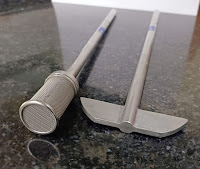
It is a widely used method for disengagement that consists of specially coated paddles that reduce disturbance due to stirring. In the paddle apparatus, the rotating shaft is attached to a blade attached vertically at the end. This blade works as a stirrer, mixing the dissolution media (buffer) which is presently added to the vessel containing the sample to be analyzed. The water (bath/tank) temperature (usually it is 370C) is maintained by the controller using a pump. The sample is usually placed in the vessel; it is allowed to sink to the bottom of the vessel before the paddle starts rotating.

Basket dissolution method:

In this technique, instead of the paddle, a separate apparatus is placed at the end of the rotating shaft, called the basket which is cylindrical and made with non-reactive mesh. The sample being tested is first placed inside a basket that is firmly attached to the end of the rotating shaft. After that, the motor is turned on and the shaft rotates the basket inside the vessel. The mesh pores allow the dissolving dosage form to pass from the basket to the holding vessel, resulting in a uniform solution.

The equipment and procedure except for the sampling process for the paddle method are similar to the rotating basket method. As per the dissolution profile, once the sample solution is withdrawn needs to be maintaining its volumes by adding dissolution medium. The samples are taken at a depth of 1 cm from the wall of the vessel, halfway between the top of the paddle (or basket) and the top of the medium. Once a sample has been filtered and needs to be analyzed, this is usually determined through UV-Vis spectroscopy or HPLC analysis.


Monday, June 14, 2021

Different types of Dissolution Apparatus As Per USP, BP, and IP

Different types of dissolution test apparatus are used for dissolution testing according to USP, BP, and IP.

The dissolution test apparatus is a device used to determine the active pharmaceutical ingredient (API) in pharmaceuticals such as tablets, caplets, or capsules for the preparation of any drug according to USP, BP, and IP specifications. It calculates adequate bioavailability and gives the necessary information in the development of solid dosage forms.

The dissolution testing is used as an official test by pharmacopoeias for the evaluation of the drug release of Capsule and tablet, etc. Dissolution testing is an important analytical procedure usually checked for the quality control, stability, and evaluation of the batch-to-batch consistency of the product.


Before a drug can start acting pharmacologically on the patient in form of solid dosage forms such as tablets or capsules, it should be first dissolved in the stomach before being absorbed into the bloodstream. This apparent first step could prove challenging for drug development. The dissolution test apparatus is therefore essential to give significant information on the in-vitro release of drugs to anticipate their behavior in-vivo.

The oral solid dosage form is still the most frequent method/route of drug administration, the rate at which the drug is released into the body after the dissolution of the dosage form has been swallowed is an important feature of drug development.

Types of dissolution test apparatus as per USP:

  • Rotating basket type apparatus-Apparatus I
  • Paddle type apparatus-Apparatus II
  • Reciprocating cylinder type apparatus-Apparatus III
  • Flow-through cell type apparatus- Apparatus IV
  • Paddle over disk type apparatus- Apparatus V
  • Cylinder type apparatus- Apparatus VI
  • Reciprocating disk type apparatus- Apparatus VII

Types of dissolution test apparatus as per IP:

  • Paddle type apparatus- Apparatus I
  • Basket type apparatus- Apparatus II

Types of dissolution test apparatus as per BP:

  • Basket Type apparatus- Apparatus I
  • Paddle Type apparatus- Apparatus II
  • Flow-through cell type apparatus- Apparatus III
types of dissolution apparatus

Overview on types of dissolution test apparatus:

There are seven USP- types of dissolution apparatus such as rotating basket type, paddles type, reciprocating cylinders, flow cell type, paddle over the disc, cylinder type, and reciprocating disk type apparatus. These are used in the pharmaceutical industry, research laboratories to provide important in-vitro drug release information for both quality control purposes.

Rotating basket (USP Apparatus 1):

It is commonly referred to as a rotating basket since it smoothly rotates and its speed complies with USP recommendations. It consists of a cylindrical basket (capacity of up to 1000 ml) which is held by a motor shaft (made of stainless steel), and the shape is semi-hemispherical at the bottom. The sample is placed in the basket, which rotates up to 100 rpm in a circular flask filled with dissolution medium. The entire flask is immersed in a constant bath temperature at 37°C. The apparatus-1 is generally preferred for capsules, suppositories, and for dosage forms that float or disintegrate slowly (delayed-release).

Paddle type (USP Apparatus 2):

Paddle type is the most widely used dissolution apparatus. It consists of specially coated paddles which reduces the disturbance due to stirring. The paddle vertically comes in contact with the bottom of the shaft and is connected to a motor that rotates at a set speed. The sample (tablet/caplet/capsule) is placed in a dissolving flask with a circular bottom to reduce the turbulence of the dissolution medium. Its operating motor speed is usually at 40 and the operating temperature is 37oC.

Reciprocating cylinder (USP Apparatus 3):

This apparatus is based on the disintegration tester and more suitable for extended-release, chewable tablets. It consists of a set of cylindrical, flat-bottomed glass outer vessels, and a set of glass reciprocating inner cylinders. Fittings and screens are made of stainless steel and other suitable materials that fit the tops and bottoms of the reciprocating cylinders.

Flow-through cell (USP Apparatus 4):

The flow-through method allows the system to be set into two types as an open system and a closed system. It consists of a reservoir for the dissolution medium and a pump that pumps the medium through the test sample-holding cell. The medium is maintained at operating temperature 37°C with flow rates ranging from 4 to 16 ml/min and up to the six samples can evaluate. The flow through the cell apparatus is used to evaluate modified-release dosage or is typically employed for low-dose medication.

Paddle over the disk (USP Apparatus 5):

It consists of a shaft and a disc assembly that can hold the sample so that the surface can be leveled with a paddle. It is most commonly used for transdermal delivery systems that are attached to a stainless steel disc, which is then placed directly on the bottom of the vessel, under the paddle.

Rotating cylinder (USP Apparatus 6):

The cylinder type apparatus is used for testing transdermal patches. It consists of a stainless steel cylinder which is used to hold the sample. Generally that sample is mounted on to cuprophan. The sample is placed inside the cylinder and will be extracted from the outside into a water bath.

Reciprocating disk (USP Apparatus 7):

The reciprocating disc equipment is suitable for small dosages and is ideal for controlled release formulations, and dosage forms that requiring a change of media. It consists of a motor and drives assembly that turns the system vertically and also consists of a volumetrically calibrated solution. A flat-bottomed cylinder-shaped vessel with a volume capacity of up to 200 ml is used in this apparatus.


Commonly asked questions on dissolution are as follows.

What is the principle of dissolution?
The significant operating principle of the paddle/basket dissolution apparatus is to offer a specific and controlled rotates and mixing mechanism at 37°C.

Which is the most widely used dissolution apparatus?
Paddle type (USP Apparatus 2) is the most commonly used apparatus for dissolution testing since it can be used for a wide range of dosage forms.

Which tablet is used in the calibration of dissolution?
The dissolution test is calibrated with Prednisone and Salicylic Acid Tablets USP, prednisone specifically for the disintegrating type, while salicylic acid is specifically for the disintegrating type.


Sunday, June 13, 2021

Difference between tonic and syrup

The major difference between tonic and syrup is that tonics are almost watery in consistency and have lower sugar content than syrup, whereas syrup is sweeter, richer, and viscous in composition and has higher sugar content than tonics.  

Pharmaceutical dosage forms are meant to deliver the active pharmaceutical ingredient (API) to the particular site within the body by using different dosages and routes of drug administration.

Based on their physical forms they are classified as solid, semi-solid, liquid, and gaseous dosage forms, and based on method/route of administration they are oral, topical, parenteral (injection), sublingual, buccal, and rectal route of drug administration.

Tablets, caplets, granules, capsules, sachets, powders, cachet, syrup, emulsion, solution, elixir, suspension, lotion, drops, liniment, ointment, cream, gel, paste, inhaler, lozenges, and aerosol, etc. are some of the examples of dosage forms.


Tonic and syrup are two general terms that are often used in the pharmaceutical field to express a wide range of medications and solutions. They both are the type of oral liquid dosage form that is more commonly and widely prescribed by doctors. Oral liquid dosage forms are easier to swallow compared to oral solid dosage forms, which are difficult to swallow, especially for children and elderly patients. 

Tonic:

Tonic is an oral liquid dosage form that refers to alternative medicines that are meant to promote vitality, health, and vigor. It may be a remedy for ailments but in general, it is a liquid consumed by people for better health, and vitality. Tonic is typically formulated with components that are beneficial to overall health, rather than focusing on one particular ailment.

Syrup:

The syrup is a viscous, thick, aqueous solution of sugar or a sugar substitute with or without flavor and medical ingredient used as an oral liquid dosage form. It is the most suitable choice for those drugs that have an unpleasant taste, its sugar contents make them pleasant. Non-medicated or flavored syrups are types of syrups that do not contain any therapeutic ingredients.

Difference between tonic and syrup:

  • Tonic is commonly used for better health, strength, and energy, whereas syrup is used to treat different kinds of diseases.
  • Tonics are almost watery in composition, whereas syrups are thick and viscous in composition.
  • Tonics formulated with less sugar content, whereas syrups are formulated with more sugar content.
  • Tonic may or may not be sweet, whereas syrups are usually very sweet because their bases are made from sugars.
  • Tonic may be suitable for diabetics, whereas syrup not suitable for diabetics.
  • Tonic is usually prescribed for adults, whereas syrup is usually prescribed for children (pediatric).
  • Tonic has a lower viscosity than syrup, while syrup has a higher viscosity than tonic.

The similarity between syrup and tonic:


Pharmaceutical syrup and tonic both are liquid dosage forms used in dealing with various ailments. Their dosage needs to be measured, mixed, or dissolved with a certain amount of water.


Saturday, June 12, 2021

Difference between moisturizer and lotion

The major difference between moisturizer and lotion is that the moisturizer is cream has a slightly thicker or lighter consistency than a lotion that is used to hydrate moisture back into the skin and has a higher water content than a lotion, while the lotion is essentially a lighter consistency of cream that has a lower water content than a moisturizer, which is used on the body for a variety of reasons.

Lotions and moisturizers are both types of creams that can be applied to the body for different uses and effects. The difference between them is where and when they are applied. Most are confused about the difference between moisturizer and lotion as the main purpose of both is to hydrate, repair, treat, regenerate and make the skin smooth and soft. Several people refer to the liquid forms of these creams as lotions and the creamier forms as moisturizers. They contain various ingredients and excipients in different proportions and are occasionally utilized for skin effects that differ from those of others.

Moisturizers:

Moisturizer is a topical cosmetic preparation specifically designed to hydrate the skin and is also used to protecting, moisture and lubricates the skin. Most moisturizers are oil-in-water emulsions and have a higher viscosity than lotions.

Moisturizers are primarily formulated to make the skin more oil, so people who have dry skin use thicker moisturizers or certain medicated moisturizers are also available to keep their skin hydrated. It can be used to prevent and treat dry skin, as well as to improve skin tone and texture, protect sensitive skin, and mask imperfections.

Lotions:

The lotion is a low viscosity topical dosage form that is applied to the skin for medicinal and cosmetic purposes. It has a less thick consistency than a moisturizer, and higher viscosity compared to the gels and cream typically due to the amount of water content used in its formulation. Most lotions are oil-in-water emulsions however water-in-oil lotions are also formulated.

The lotion can also be applied with bare hands on the skin as a drug delivery system, particularly body lotions, hand lotions, and medicated lotion that are meant to the skin treat, soften, moisturize, smooth, and sometimes perfume the skin.

Difference between moisturizer and lotion:

  • Moisturizers have low water and high oil base, while lotions have low oil and high water base.
  • Moisturizers are used to moisturize the skin, treat dry skin, protect sensitive skin, improve skin tone and texture, while lotions can be used for several purposes such as antiseptics, anti-acne, protective, antibiotics, moisturizing, soothing, and smoothing the skin.
  • Moisturizers have a slightly thicker consistency, while lotions are essentially light and thinner consistency.
  • Moisturizers are typically designed for application to the face, while lotions are primarily designed for application to the body.
  • Moisturizers penetrate the skin quickly, while lotions take longer to penetrate.
  • Moisturizer is suitable for dry or normal skin, while creams are generally suitable for oily or normal skin.
  • Moisturizer is more preferred in the winter (cold) season, while lotion can be used in all seasons.

The similarity between lotions and moisturizers:

The major similarity between lotion and moisturizer is that both lotions and moisturizers are semisolid topical preparations that are applied to the body and face for cosmetic as well as medicinal purposes.


Commonly asked questions are as follows.

What skin type is the moisturizer suitable for?
Depending on the skin type, moisturizers can be beneficial for both dry and oily skin types. When you choose a moisturizer, you need to consider your skin type. In any case, it's important to know your skin types so that you know what the products do for your skin.

Is body lotion the same as a body moisturizer?
Yes, a lotion is a moisturizer that has a lighter consistency and contains less oil than a cream. Lotions are suitable for oily skin and can be applied in summers.

What are the examples of dosage forms?
Dosage forms are the means by which active pharmaceutical ingredients (drug) are delivered to the specific site of the body, some of the examples of dosage forms are tablets, capsules, caplets, granules, powders, syrup, tonic, drops, suspension, solution, liniment, elixir, linctus, lotion, cream, ointment, gel, and paste, etc.


You may also like this

Thursday, June 10, 2021

Difference between syrup and tablet

The major difference between syrup and tablets is that the syrup is a liquid dosage form (preparation), while tablets are a solid dosage form (preparation).

Dosage forms are pharmaceutical formulations that a mixture of active pharmaceutical ingredients (API) with excipients in a particular configuration to allow easy and accurate administration and delivery of active medicinal substances. It refers to the physical form of a drug or the dosage of a chemical compound for administration or consumption as a drug.

There are different types of dosage forms, based on the physical form and depending on the method/route of delivery of the drug. Based on the physical form they are solid, liquid, semi-solid, and gaseous dosage forms. Based on the route they are oral, topical, parenteral (injection), inhalation, and sublingual routes of drug administration are available, and some are instilled in body cavities.

Tablets, caplets, capsules, powders, granules, sachets, lozenges, cachet, gel, paste, cream, ointment, liniment, drops, syrup, suspension, emulsion, lotion, elixir, solution, inhaler, and aerosol, etc. are some of the examples of dosage forms.

Syrup:

The syrup is a liquid oral dosage form in which sugar and drugs are completely soluble. This solute completely dissolves in the solvent, and the resulting mixture is known as a solution. The syrup is a thick, viscous, monophasic liquid system containing a homogeneous mixed active ingredient with or without flavoring ingredients.

The syrup is a convenient way to take unpleasant-tasting medicine in liquid form. Antitussive (cough suppressant) and antihistamine agents are the most commonly used medications in medicated syrups.

Tablets:

Pharmaceutical tablets are solid dosage forms that usually contain a mixture of active ingredients and excipients, usually in powder form, which is compressed or molded from a powder into a solid dosage form.

They are usually flat, round in shape, and have coated or uncoated to mask the unpleasant taste and odor of the drug or to control the rate of absorption in the body. Based on their intended application and manufacturing method, they can vary in shape, size, weight, hardness, thickness, dissolution, and disintegration properties.

The pharmaceutical manufacturers formulate different types of tablets based on the route of administration and function such as compressed tablets, film-coated tablets, enteric-coated tablets, sugarcoated tablets, modified-release tablets, chewable tablets, effervescent tablets, dispersible, buccal and sublingual tablets.

Difference between syrup and tablet:

  • The syrup is a liquid preparation that is easy to swallow, whereas tablets are solid preparation that is stiff and hard may be more difficult to swallow, especially for the elderly and child patients.
  • The syrup required more ingredients to formulate than tablets, whereas tablets required fewer ingredients to formulate than syrup.
  • Limited drugs are suitable with syrup due to their liquid properties, whereas a wide range of drugs is compatible with tablets due to their solid properties.
  • The syrup is less likely to have an unpleasant taste or smell, whereas tablets are likely to have an unpleasant taste or odor.
  • The syrup has to be measured at each dose, which may change the dosage of the medicine, whereas tablets do not need to be measured and can be taken whole (intact).
  • Syrup allows for dosage flexibility (variation), whereas tablets do not.
  • Syrup may faster onset of action, whereas tablets may prolong, extended, sustained, and controlled release.
  • Syrups have a shorter shelf life, whereas tablets have a longer shelf life.
  • Syrups have limited forms, whereas tablets come in different forms.
  • The syrup is less stable than tablets, whereas tablets are more stable than syrup.
  • Syrups are generally more expensive than tablets, and tablets are usually less expensive than syrup.
  • The syrup is difficult to handle, transport and storage, whereas tablets are rather easy and safe to use.
  • The syrup is absorbed more completely and quickly, whereas tablets are absorbed more slowly than syrup.
Syrup vs Tablet
Difference between syrup and tablet

Similarities between tablet and syrup:

Syrups and tablets both are the pharmaceutical preparations that are the most commonly prescribed medication by doctors both are used for the same purposes and have the same power.

Is syrup better than tablets for cough?

Tablets and syrups have their advantages; however, the syrup is more preferable compared to tablets for cough since the medicine is already a liquid that works mechanically


Tuesday, June 8, 2021

Difference between syrup and drops

The major difference between syrup and drops is the concentration and composition of the medication. Drops have a lower dosage of the drug, while syrup has a higher dosage of the drug.

Pharmaceutical dosage forms are the means by which active pharmaceutical ingredients (API) are delivered to sites of action within the body, they need for the protection, precise dose, and to improve the drug release rate in the form of sustained, controlled, extended, and prolonged-release.

They are classified according to their physical form as solid, liquid, semi-solid, and gaseous dosage forms, and according to their route, they are classified as oral, parenteral (Injection), and topical route of drug administration. Tablet, capsule, granules, powder, syrup, drops, suspension, solutions, mouthwash, colloids, elixir, linctus, ointment, cream, paste, gel, lozenges, suppositories, aerosol, spray, and inhaler are some of the examples of dosage forms.

Oral liquids are commonly used by patients who have difficulty swallowing solid oral dosage forms (tablets and capsules) such as children and the elderly. They are homogeneous liquid preparations, usually a solution, an emulsion, or suspension of one or more drugs in an appropriate liquid base. Oral liquid dosage forms are commonly divided into two forms such as monophasic and biphasic.

Syrups:

Pharmaceutical syrups are saturated aqueous solutions of sugar (sucrose) in water or other aqueous liquids, with or without flavoring agents and medicinal substances. One advantage of syrup is that it masks the unpleasant taste and odor of the drugs, and it is easy to oral administration compared to tablets and capsules.

The pharmaceutical syrup or medicinal syrup is an oral suspension in liquid form used as a flavored vehicle for drugs. Medicinal syrups are commonly used as a pediatric treatment, although they are also available in different types for adults. It should be stored in an airtight container in a dry and cool place after use to preserve them.

Drops:

Pharmaceutical oral drops are liquid preparations for children under the age of one year that are designed to be administered in small doses with the use of a proper measurement device. They are homogenous mixtures in which each drop of solution contains an equal amount of drug.

It is a homogenous mixture with an equal number of parts at every drop of the solution, contains very minute chemical entities, and formulation is designed specifically for a child under the age of one year. Other than oral drops, there are many types of drops available, such as ear drops, eye drops, etc. 

Difference between syrup and drops:

  • The syrup is commonly used as a pediatric medication and is also available in many forms for adults, whereas drops are mainly formulated for infants.
  • The concentration of drugs in syrup is more whereas the concentration of drugs in drops will be less.
  • Pharmaceutical syrups are thick and viscous, whereas oral drops may or may not be thick and viscous.
  • Syrup may not be acceptable for diabetics, whereas drops may be acceptable for diabetics.
  • The syrup is a mixture of active ingredients with sugar or any other sweetening agents in water or other aqueous liquids, whereas the drops are a combination of solvent and solute with suitable excipients.
  • The syrup is sticky, opaque, and cloudy in appearance, whereas drops are non-sticky, transparent and light can pass through it.
  • Syrup can leave stains on clothes, whereas drops cannot leave stains on clothes.
  • The syrup needs to be measured by spoon or suitable multidose containers, whereas drops required a dropper.
  • The oral syrup is always sweet as it has high sugar content, whereas oral drops are not always sweet.

Similarities between oral drops and oral syrup:

Oral drops and syrups are homogeneous mixtures formulated to release the active pharmaceutical ingredients (API) after oral administration to attain rapid and complete systemic absorption of medication than the solid oral dosage forms. Both are the most commonly prescribed drugs that are available in a liquid format that can make taking the medicine easier.


Commonly asked questions on syrup and drops are as follows.

What is the difference between paracetamol syrup and drops?
Pediatric drops of paracetamol have a higher concentration as compared to syrup.

What are the examples of syrup and drops?
Paracetamol, maxtra, colicaid, and zincovit are some of the examples of marketed preparations of syrups and drops.


Monday, May 24, 2021

Difference between liniment and ointment

The major difference between liniment and ointment is that the liniment is a topical remedial preparation that is used to rub the skin with friction to relieve arthritis symptoms, whereas ointment is a viscous, oil-based preparation that is applied to the skin for medicinal or cosmetic purposes.

Dosage forms are means to deliver active pharmaceutical ingredients (API) to the specific site of the body. Dosage forms are classified as solid, semi-solid, liquid, and gaseous depending on their physical properties, and depending on the route of drug administration they are oral, sublingual, parenteral (Injection), and topical routes. Gel, paste, ointment, cream, suppositories, capsule, tablet, granules, powder, solutions, elixir, drops, syrup, suspension, linctus, colloids, mouthwash, lozenges, aerosol, spray, and inhaler are examples of dosage forms.

Semi solids are topical dosage forms that can be applied to the skin or mucous membrane for therapeutic, cosmetic, or protective purposes. They contain one or more medicines as well as excipients that are dispersed in a suitable base. Because of its advantages, convenience, and affordability, topical administration is the preferred route for local delivery of therapeutic agents.

Liniment:

Liniments are a liquid or semi-liquid formulation that is applied to the skin to reduce pain or relieve stiffness. They are alcoholic or oleaginous solutions or emulsions of different therapeutic substances intended to be rubbed on the skin. Liniments containing insoluble substances that have to be thoroughly shaken before use and are only intended for external use.

Ointment:

The ointment is an oil-based topical formulation with a semisolid texture and a greasy appearance that can be used as moisturizers, medications, or cosmetics on the skin, eyes, and mucus membranes. Ointments usually contain 70% or more oil, making them thick, greasy, and sticky. The viscosity of the ointment ensures that the drugs in it are completely absorbed by the skin and prolonged action.

Difference between liniment and ointment:

  • Liniments are alcoholic or oleaginous-based solutions, while ointments are oil-based topical formulation.
  • Liniments are not greasy and oily, while ointments are very greasy and oily.
  • Liniments are usually applied to the skin by rubbing and friction, while ointments are applied to the skin without friction.
  • Liniments are not used on damaged or unbroken skin because they cause irritation, while ointments can apply directly to the damaged or inflamed region.
  • The liniment is applied to relieve pain, and swelling of joints, while ointment is used for medicines, moisturizers, or cosmetics.
  • The liniment is less viscous than the ointments or creams, while the ointments have a higher viscosity than the liniment.
  • Liniments are used for all forms of skin, except damaged or unbroken skin, while ointments are better suited to dry or very dry skin.
  • Liniments are liquid and spread easily on the skin, while ointments are sticky and difficult to spread on the skin.
  • Liniments are less likely to stain clothing, while ointments, lotions, and creams, can stain and leave an oily residue on clothing.
Difference between liniment and ointment

The similarity between liniment and ointment:

The major similarity between liniment and ointment is that they both are topical dosage forms intended to use on the skin for medicinal or cosmetic purposes.

Commonly asked questions on liniments and ointments are as follows.

Why is liniment not applied to broken skin? 
Liniment should not be applied to broken or damaged skin as it will irritate it, especially if the solvent is alcohol.

What is the difference between emollient and liniment?
Emollient is substances that moisturize and soften the skin, whereas liniment is a topical medical preparation intended to rub into the skin with friction.