Monday, April 19, 2021

Difference between syrup and suspension

The major difference between syrup and suspension is that the syrup is a concentrated mixture of sugar and water whereas suspension is made up of fine particles of an undissolved solid that are dispersed in a liquid medium.  

The dosage forms are the different drug products they are classified according to the route of drug administration and according to the physical form. Medicines and drugs come in different forms they can be solid, semisolid, liquid, and gaseous dosage forms and they can be administered orally, topically, parenterally, inhalation, and instilled in body cavities. Some examples of dosage forms are tablets, capsules, granules, emulsion, syrup, suspension, elixirs, parenteral preparations, lotions, linctuses, eardrops, suppositories, troches, gels, paste, creams, ointments, and mouthwash, etc.


Oral liquids are homogeneous liquid formulations that typically consist of one or more active pharmaceutical ingredients in a suitable solution, emulsion, or suspension. Oral liquid dosage forms are usually classified into two types- monophonic and biphasic. It is more suitable for patients particularly for children and elderly patients who have difficulty swallowing tablets or other solid medication. Liquids are absorbed faster, more palatable than solids, have more flexibility to formulated and it does not have an unpleasant taste and odor these are some of the advantages of liquid dosage forms.

The pharmaceutical suspension and syrup are both liquid oral dosage forms although they have some differences in their nature and properties, let's check them.

What is syrup?

The pharmaceutical syrup is a viscous oral liquid consisting primarily of sugar or any other sweetening agents. It is one of the dosage forms in which drugs with preservatives and excipients are made soluble in the liquid. Some syrup is less viscous, some are more viscous, and their viscosity depends on the sweetness concentration used in the formulation. There are three types of syrups, simple syrup, medicated syrup, and flavored syrup, and these are best suited for pediatric use.

What is suspension?

Pharmaceutical suspension is a semi-solid or biphasic liquid dosage form, in which the internal phase is dispersed uniformly throughout the external phase, resulting in a coarse dispersion. The internal phase ranges from 0.5 to 5 microns in size, whereas the outer phase, which is usually aqueous in some instances, maybe organic or oily liquid for non-oral use. Oral suspensions, parenteral suspensions, ophthalmic suspensions, and suspensions for external use are the four major types of suspensions based on their pharmaceutical use. 

Difference between syrup and suspension:

  • A syrup is a solution that completely dissolves into its solvent, whereas a suspension is a mixture of solutes in which the drug particles do not completely dissolve in the solvent.
  • The syrup may not be suitable for patients with diabetes due to the high amount of sugar, while the suspension may be appropriate because it does not make with sugar.
  • Syrups are dissolved in various solvents such as sugar or alcohol, while suspensions are dissolved in water.
  • The syrups are suitable for children because the sugar in the formulation masks the bitter or unpleasant taste, while the suspension may not be suitable for children due to unpleasant taste.
  • The pharmaceutical syrup is a solution that fully dissolves into its solvent, so it does not need to be shaken, while suspensions need to shake well before administration, as the drug particles settle to the bottom upon long-standing.
  • Pharmaceutical suspension products require labeling such as "shake well before use", while syrup does not require this type of labeling.
Syrup VS Suspension
Difference between syrup and suspension

Commonly asked questions on syrup and suspension are as follows.

What is the similarity between syrup and suspension?
The major similarity between syrup and suspension is that both are drugs and medicines suspended in a type of a dissolvent.

Is syrup a colloid or suspension?
The syrup is a suspension solution, not a colloid.

Is liquid medicine a suspension?
Liquid suspension occurs when a medication is prepared in a liquid form that may be a suspension, syrup, or solution in nature.


Saturday, April 17, 2021

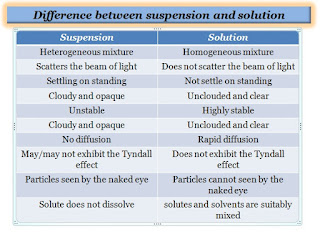
Difference between suspension and solution

The major difference between suspension and solution is that the suspensions are a heterogeneous mixture, which means that the components do not mix completely and will most likely separate in the near future whereas, the solutions are homogeneous mixture since the components mix well together and remain mixed without separation.     
Suspensions and solutions are both mixtures of various substances that are formed by combining one or more substances with different properties. Suspension, solution, colloids, and other dispersions are parallel however they have characteristics that differentiate each other.

Suspension:

A suspension is a heterogeneous mixture of particles that have a diameter greater than 1000 nm and are visible to the naked eye. It is a heterogeneous mixture consisting of solid particles sufficiently large for sedimentation. All particles are completely mixed in this form of a mixture and can be seen under a microscope but light cannot pass through them.

When insoluble solid particles are dispersed in a liquid medium, they form a suspension. The solute particles are uniformly dispersed in the medium when shaken, but if left undisturbed, the solute particles, which vary in size from 0.5 to 5 μm, settle and can be isolated from the solution by filtration or centrifugation. They are classified according to their dispersion phase that can be solid and their dispersion medium which can be solid, liquid, or gas.

Examples of suspension:

  • Sand in water
  • Milk of magnesia
  • Dusty air
  • Paints in which dyes are suspended in turpentine oil
  • Flour in water
  • Muddy water  

Solution:

A solution is a clear homogeneous mixture and solute particles no longer appear nor do they settle. The particles of solute have dimensions of molecular size and do not disperse the light beam passing through it. The solution has two components, solute, and solvent; a solute is a substance that is to be dissolved, and a solvent is a substance that dissolves the solute through a chemical change.

Since the composition is homogeneous, it is not possible to separate the solute from the solvent by filtering. Distillation is the only alternative, as it extracts the solvent while leaving a solid residue of the solute behind. The true solution, colloidal solution, and suspension are the three types of solutions that are classified based on the nature of particle sizes. These types of solutions show substantial differences in their nature, filterability, appearance, and color.

Examples of solution:

  • Salt solution
  • Alcohol in water
  • Tincture of iodine
  • Sugar solution
  • Soda water  

Difference between suspensions and solutions:

  • Suspension is a heterogeneous mixture whereas the solution is a homogeneous mixture type.
  • In suspension, the solute does not dissolve, it is suspended in the liquid and settled in the medium, while in solution, the solutes and solvents are suitably mixed in the liquid phase.
  • Suspension scatters the beam of light, while the solution does not scatter the beam of light.
  • The particle size of the suspension is more than 100 nm, whereas the particle size of the solution is less than 1 nm.
  • Suspension may or may not exhibit the Tyndall effect which depends on the type of mixture, while the solution does not exhibit the Tyndall effect.
  • The particles of a suspension can be seen by the naked eye whereas the particles of a solution are at the ion or molecular level and cannot be seen with the naked eye.
  • The suspension is unstable, whereas the solution is highly stable.
  • The suspension is cloudy and opaque, whereas the solution is unclouded and clear in appearance.
  • The suspension is settling on standing, while the solution is not settled.
  • There is no diffusion in the suspension, while rapid diffusion occurs in the solution.
  • The suspension particle does not pass through the filter paper, while the solution passes through the filter paper. 
Suspension VS Solution
Difference between suspension and solution

Commonly asked questions are as follows.


What are the different types of the solution?
Solid-solid, solid-liquid, solid-gas, liquid-solid, liquid-liquid, liquid-gas, gas-solid, gas-liquid, and gas-gas are the types of solution.

How is a solution similar to a suspension?
Both solution and suspension are mixtures of two or more components and none of those components are chemically bonded together. The components in both solution and suspension can be isolated based on their physical properties by size, solubility, and density.

What are Colloids?
A colloid is a mixture in which one material is suspended in another by microscopically scattered insoluble particles. Example: milk, butter.

Which dosage form is semi-solid oil in water emulsion?
The cream is semi-solid oil in water emulsion that comes in two types: oil-in-water (O/W) and water-in-oil (W/O).


Saturday, April 10, 2021

Semi solid dosage form and its classification

Learn about semi-solid dosage forms and their types, packaging, and storage of semi-solid dosage forms, ideal properties of semisolid dosage for, and excipients or additives used in the semi-solid dosage form.

Medication is more effective when it reaches its site of action therefore the different routes and dosage forms are used to treat various diseases. Dosage forms are the way by which active pharmaceutical ingredients (API) are delivered to sites of action within the body to achieve the optimum desired results with the least amount of side effects. It consists of a combination of drugs and excipients, prepared in a specific configuration and apportioned into a specific dose.

Based on the physical state the pharmaceutical dosage forms are classified as solid, semi-solid, liquid dosage forms, and gaseous dosage form and based on route of administration the pharmaceutical dosage forms are classified as oral, parenteral, topical, rectal, inhaled, ophthalmic, buccal and sublingual route of drug administration.


What is a semi-solid dosage form?

Semisolids are neither solid nor liquid they are a combination or mixture of both and are used for both local and systemic effects. It is intended used as drug carriers that are transported topically through the skin, rectal tissue, buckle tissue, urethral membrane, outer ear lining nasal mucosa, and cornea, etc.
The drug substances are generally applied to the skin in the form of semi-solid formulations for topical treatment of skin diseases or to improve the condition of the skin. The skin can also be recognized as an alternative option of entry for systematically acting drugs since many patients particularly children and elders have faced problems taking medicines orally or the parenteral route.

Types of semisolid dosage forms:

Semisolid dosage forms can be classified into two types, internal and external.
  • Internal: examples- suppositories, and pessaries, etc.
  • External: examples- ointments, creams, pastes, and jellies, etc.
Semi solid dosage form and its classification

Definitions: Semisolid dosage forms:

Creams: Cream is a semisolid dosage form for external use containing one or more active ingredients dispersed or dissolved in a suitable fatty base.
Ointments: Ointments are semisolid preparations for external use containing with or without active ingredients with a suitable ointment base, intended for application on the skin to soothe or heal wounds, scrapes, rashes, burns, or other skin problems.
Gels: Gels are semisolid preparations intended for application on the skin, containing hydrophilic or hydrophobic bases with gelling agents.
Paste: A paste is semisolid dosage forms containing a high proportion of finely powdered medicaments with a suitable fatty base intended for topical application.
Poultices: A poultice is a semi-solid made up of a soft, moist mass created by wetting a solid absorbent material. It is for external use containing active ingredients applied to the skin to hold the dressing and protective.

Ideal properties of semisolid dosage forms:

Physical properties: Non-gritty, smooth texture, elegant in appearance, non-hygroscopic, non-greasy, and non-staining.
Physiological properties: Miscible with skin secretion, non-irritating, do not alter membrane or skin functioning, and have a low sensitization index
Application properties: Easily applicable with efficient drug release and high aqueous washability.
Storage properties: Its store temperature should not exceed 25°, Should not be allowed to freeze and stored in a well-closed container.

Mechanism of drug penetration through the skin:

Three possible entry macro routes to the viable tissue:
1. Via the sweat ducts
2. Across the continuous stratum corneum
3. Through the hair follicles with their associated sebaceous glands

Factors affecting semisolid dosage forms:

  • The medication incorporated into the semisolid base should reach their site of action, for the effectiveness of the formulations. The skin, on the other hand, acts as a barrier, preventing molecules from the administered medications from entering the body.
  • Physio-chemical and biological are the two major factors that affect the dermal penetration of the drug.

List of excipients or additives used in semi-solid dosage forms:

  • Sweetening agents
  • Solubilizing agents
  • Flavoring agents
  • Coloring agents
  • Preservatives
  • Antioxidants
  • Thickening agents
  • Binding agents
  • Suspending agents
  • Lubricants
  • Solvents
  • Perfumes

Packaging and storage of semi-solid dosage forms:

  • Aluminum, metal, or plastic tubes are used to package ointments and other semisolid formulations.
  • The tubes are tested to ensure that they are compatible and stable with the intended product.
  • Tubes used to pack the final topical product are easier to use for patients, lighter, compatible with most drugs and excipients, cost-effective, and offer better protection against external contamination and environmental conditions.
  • Tubes of aluminum generally are coated or laminated to eliminate any interactions and protect from moisture.
  • All containers are sterilized before being filled.
  • Semisolids should be store in tightly closed containers to avoid contamination and in a cool environment to avoid product separation due to heat (temperature).
  • Light-sensitive preparations are packaged in light-resistant containers when necessary.  
Commonly asked questions o dosage forms are as follows.

Which dosage form is semi-solid oil in water emulsion?
Creams are semi-solid emulsions of oil and water that come in two types: oil-in-water (O/W) and water-in-oil (W/O).

How are the ointments classified?
Ointments are classified based on penetration and the basis of therapeutic use.

What is the advantage of a semi-solid dosage form?
The major advantage of a semi-solid dosage form is that it can be applied directly to the affected area, has a longer duration of action, and does not require oral administration.


Friday, April 2, 2021

Advantages and Disadvantages of Gas Chromatography

Chromatography has evolved, from paper chromatography to TLC and chromatography to instrumental techniques including GC and HPLC. Gas chromatography (GC) is the significant analytical method for the separation of volatile compounds in a mixture by injecting a liquid or gaseous sample into a mobile phase, usually called the carrier gas, and passing the gas through a stationary phase. The mobile phase consists of an inert gas it may be nitrogen, helium, or argon and the column can be packed or capillary they can available in different diameters and lengths as per the requirement of the sample.
This kind of chromatography isolates analytes based on the volatility of analytes. The more volatile compound will be separated rapidly, whereas the less volatile compound will gradually be eluted from the column. The gas chromatography follows the principle of the partitioning of volatile compounds with mobile phase and stationary phase.
Several detector options are available with high sensitivity, to detect a wide range of samples that is not possible with other chromatographic techniques. The different types of GC detectors are flame ionization (FID), thermal conductivity, nitrogen phosphorous, photo-ionization, electron capture, flame photometric, electrolytic conductivity detector, and mass spectrometer, etc.

Advantages of gas chromatography (GC):

  • The major advantage of gas chromatography is its high sensitivity, resolution, and separation ability, which allows it to separate a wide range of volatile compounds.
  • It can be upgraded to a mass spectrometer (MS), which is used to determine the mass-to-charge ratio of ions.
  • It comes with a variety of detectors and injectors that can be used for various pharmaceuticals as well as other applications.
  • Gas chromatography can analyze a sample much faster than other chromatographic techniques.
  • It is a robust method of separation that gives the superior signal-to-noise ratio.
  • It only takes a very small amount of sample to inject, and its detectors are extremely sensitive, allowing it to detect extremely low concentrations (ng-pg).
  • As per the requirement of the molecule, there are different types of GC columns are available in many diameters and lengths.
  • Gas chromatography is easy, automated, and has quick analysis of data which gives comparatively high precision, accuracy, and reproducible results.
  • Operational parameters such as flow rate, temperature, and pressure, etc. are easy to change even during chromatographic runs.

Disadvantages of a gas chromatography (GC):

  • The major disadvantage of GC is that only volatile and thermally stable compounds can be separated using gas chromatography.
  • Detectors which are used in the GC are destructive, except for MS.
  • Selectivity in HPLC or TLC is also better as a mobile phase can be easily changed. In GC, you can just modify the temperature of the column and oven, but you cannot change the mobile phase as it has a constant flow of carrier gas (helium, nitrogen).
  • Since hydrogen gas, which is used for flame, is highly flammable, care must be taken when using it.
  • It is impossible to recover individual sample components.

Commonly asked questions on gas chromatography are as follows.


What is the advantage of gas chromatography over liquid chromatography?

The major advantage of gas chromatography over liquid chromatography is that, as compared to high-performance liquid chromatography, the column length of GC is longer, allowing for the separation of more complex sample mixtures with high resolution.

What is the advantage of GC over TLC?

The major advantage of GC over TLC is that the GC is an automated quantitative technique in which software can offer precise data such as peak area, resolution, tailing factor and height, etc. Whereas TLC is only separates the compounds and is not for quantitative analysis.

What are the disadvantages of hydrogen in gas chromatography (GC)?

It can decrease the resolution of the chromatogram, hydrogen can react with unsaturated components on the metal surface, and in GC-MS it can reduce the efficiency of turbo molecular vacuum pump these are some disadvantages of hydrogen in GC.


You may also like this

Difference between TLC and Paper Chromatography

The major difference between TLC and paper chromatography is that the TLC uses the stationary phase as alumina, silica, and its compositions, whereas in paper chromatography, specialized cellulose paper is used as a stationary phase to separate the analytes.
 
TLC and paper chromatography both are separation techniques of chromatography, which are used to separate the components or biomolecules such as carbohydrates, amino acids, and proteins. As a stationary phase, the paper chromatography uses cellulose paper, and the separation mechanism depends on the solid-liquid adsorption. The same adsorption mechanism uses in thin layer chromatography, depending on solubility in the mobile phase the molecules or components are separated on the stationary phase.

Particle separation in both paper and thin-layer chromatography is based on the polarity of the molecules on the stationary and mobile phase. After the chromatograph is completed, the different spots will appear, and the Rf factor will be determined.

Thin Layer Chromatography:

TLC is a separation technique of chromatography, which works based on the solid-liquid adsorption of compounds. It has a stationary phase of silica gel or alumina and a solvent in the form of a mobile phase, where the particles are separated based on their polarity towards both phases. In TLC the colored compounds appear as colored spots and colorless compounds are seen under UV light (UV cabinet) or using a spraying solution (Ninhydrin).

Paper Chromatography:

Paper chromatography is a separation technique used to separate compounds based on their liquid-liquid adsorption and solubility of the compound. The paper acts as a stationary phase and the mobile phase is liquid, and the particles are isolated according to their polarity toward both phases. In paper chromatography, the colored compounds appear as colored spots and colorless analytes are seen under using a spraying solution (Ninhydrin).

The key differences between thin layer chromatography (TLC) and paper are as follows:

  • TLC is based on the principle of "adsorption," whereas paper chromatography is based on the principle of "partition".
  • TLC is based on solid-liquid absorption whereas paper chromatography is based on solid-liquid absorption.
  • The glass plates coated with silica gel acts as the stationary phase in TLC whereas the water trapped in the cellulose filter paper acts as a stationary phase of paper chromatography.
  • Thin-layer chromatography takes more time in preparation, whereas paper chromatography takes less preparation.
  • TLC allows the use of corrosive reagents, while paper chromatography does not because the corrosive agents may damage the paper. This is due to the TLC plate is resistant to strong solvents and color-creating agents.
  • Paper chromatography rapidly separates the molecules whereas thin layer chromatography requires more time.
  • In TLC the individual spots of solutes can be seen under UV-lamp whereas in paper chromatography cannot be evaluated under the UV light.
  • The development of chromatogram takes place (flow of mobile phase) in paper chromatography can ascending, descending, radial, and two-dimensional whereas the flow of mobile phase in TLC chromatogram develop in ascending order.


Thursday, April 1, 2021

Ideal properties of semisolid dosage form

A pharmaceutical dosage form is a physical form of a drug, such as a solid, liquid, or gas, that is delivered in its proper form to specific sites of action within the body. The commonly used dosage forms include tablets, solutions, capsules, injections, semisolids, and aerosols they deliver the active pharmaceutical ingredient using different routes of drug administration such as oral, parenteral (Injection), topical, sublingual, and buccal.

Semi solids are topical dosage forms intended for therapeutic, protective, or cosmetic and can be used as drug carriers that are transported topically through the skin, outer ear lining nasal mucosa, rectal tissue, buckle tissue, and cornea. Semi solids contain one or more active pharmaceutical ingredients homogeneously dispersed (dissolve) in a suitable base and any appropriate excipients. Ointments, cream, pastes, gels, rigid foams, and plasters, etc. are examples of the semi-solid dosage form.

Ideal properties of semi solids:

Various routes and dosage forms are used to make the drug more effective in which topical or semisolid formulation is ideal for the skin.
 
Physical properties:
  • It should have a smooth texture
  • It should be elegant in appearance
  • It should be non-dehydrating
  • It should be non-gritty
  • It should be non-greasy and non-staining
  • It should be non-hygroscopic
Physiological properties:
  • It should be non-irritating
  • Do not alter membrane or skin functioning
  • It should be miscible with skin secretion
  • It should have a low sensitization index
Application properties:
  • It should easily applicable with efficient drug release
  • It should have a high aqueous washing ability
Storage properties:
  • Its store temperature should not exceed 25° degrees
  • Should not be allowed to freeze and stored in a well-closed container
Ideal properties of semisolid dosage form

Ingredients desirable for semisolid dosage form:

  • Bases
  • Humectants
  • Preservative
  • Antioxidants
  • Gelling agent
  • Emulsifier
  • Buffers
  • Permeation enhancer

Ideal properties of the base which used in semi solids:

The base is the most essential ingredient used in the semisolid dosage form. Ointment bases not only work as carriers for pharmaceuticals, although they also regulate the amount of absorption of medicaments incorporated in them.
  • It should be inert, non-irritating and non-sensitizing
  • It should be compatible with the skin pH and the drug
  • It should be a good solvent and/or emulsifying agent
  • It should be emollient, protective, non-greasy, and easily removable
  • It should release medicaments readily at the site of application
  • Pharmaceutically elegant and possess good stability

Factors that affect skin penetration:

Biological and physio-chemical are the two major factors that affect the dermal penetration of the drug.
Biological factors influencing skin absorption are skin condition, skin age, blood flow, region skin site, skin metabolism, and species difference, etc.
Physio-chemical factors influencing skin absorption are skin hydration, temperature and pH, diffusion coefficient, the concentration of the drug, partition coefficient, and molecular size and shape.
 
 
You may also like this
 

Wednesday, March 31, 2021

Principle and applications of gas chromatography

Gas chromatography is the most widely used analytical method for quality control as well as identification and quantification of molecules in sample mixtures in many research and industrial laboratories. GC is frequently used in many applications of forensic and environmental as it allows for very small amounts of detection. A large range of samples can be determined as long as the analytes are enough thermally stable and are relatively volatile. Depending on the stationary phase used there are two types of GC, such as gas-liquid chromatography (GLC) and gas-solid chromatography (GSC).

Principle of gas chromatography (GC):

Gas chromatography is a technique for separating and quantifying vaporized analytes using an inert carrier gas (Nitrogen or Helium). The GC works on the same principles as column permeation chromatography, in which analytes are dissolved in the mobile phase and moved through a porous stationary phase. The basic principle involved in gas chromatography is partitioning, in which the analytes are distributed or partitioned between the two-phase i.e. stationary phase and mobile phase. The analytes are separated based on their affinity, the more affinity will elute slowly while lower affinity toward the stationary phase will elute rapidly from the column.

Gas-liquid chromatography (GLC) is the most regular form of GC, in that a stationary phase is a non-volatile liquid. The stationary phase can be coated on small inert solid particles packed in a coiled metal or glass column. Most analyzes of GC performed in the early years of GC using this kind of packed column. But, in recent years the capillary columns have been widely used since it has more separation efficiency and sensitivity. The carrier gas, sample injection port, column, column oven, and detector, etc. are the components essential to perform the process of GC.

Applications of gas chromatography (GC):

Pharmaceutical applications of GC: The gas chromatography is widely used for the qualitative and quantitative analysis of a sample of formulations and medicinal products in pharmaceutical production. 
Analysis of food, flavors, and fragrances: The quality and quantity of fragrances, flavors, and food products are required to be maintained; hence GC is used to analyze them. It is also used to determine the pesticides, and contaminants from foodstuff, vegetables, and fruits.
Applications of GC in the analysis of pesticides: The column of GC provides high resolution, efficiency, and exceptional inertness towards neutral, basic, and acidic compounds, therefore, it is appropriate for the analysis of volatiles and pesticides.
Applications of gas chromatography in academic research: GC-MS is the most powerful technique, it is used for the identification and characterization of molecules, which provide high resolution compared to the HPLC column.
Environmental applications of gas chromatography: GC is the most generally used technique for the identification of organic molecules in environmental samples. 
Applications of GC in clinical and forensic purposes: In several fields of forensic science the gas chromatography is used, ranging from the analysis of crime investigations, alcohol, and drug abuse. It is also essential in clinical applications to the analysis of drugs in the blood.
Applications of GC in a variety of industries: Gas chromatography has wide applications in many industries such as the petroleum industry, food industry, beverage industry, pharmaceutical industry, 
chemical industry, and gas industry, etc. 

Applications of gas liquid chromatography: 

A major trend in the field is combining substantial fractionation properties of gas-liquid chromatography with better analytical properties of instruments such as ultraviolet (UV), infrared spectrophotometer (IR), mass (MS), and NMR. In its application for chemical problems, the system must distinguish between two functions operating. The first is as a tool for isolation. In this capacity, it is unmatched, applied to biochemical systems, metal-organic and complex organic.

The second is to offer a means to complete the analysis. Here, the retention time of the compound is working for qualitative detection, while the peak area/height gives quantitative information. In comparison to other approaches, gas-liquid chromatography is a relatively underutilized analytical technology, as it is working with volatile components.


Commonly asked questions on chromatography are as follows.


Which factors influence the separation of the components in gas chromatography?

The separation of the components in GC is affected by the vapor pressure, length of the column, the polarity of analyte versus the polarity of stationary phase on the column, the temperature of column and oven, the flow rate of carrier gas and amount of sample injected.


What is the most commonly used detector in gas chromatography?

There are many types of detectors are used in gas chromatography such as flame ionization detector (FID), thermal conductivity detector (TCD), mass spectrometer (GC/MS), thermal conductivity detector (TCD)and electron capture detector (ECD), but out of these, the flame ionization detector is most commonly used detector in gas chromatography.


What is the major difference between GC-MS and LC-MS?

Both GC-MS and LC-MS are separation technique used to separate the compounds. The major difference between GC-MS and LC-MS is that the in GC-MS mobile phase uses as inert gases such as nitrogen or helium, whereas LC-MS uses a solvent or mixture of solvents as its mobile phase.


Monday, March 29, 2021

HPLC column care and maintenance

The column is such an essential part for the separation in high-performance liquid chromatography, hence the proper care and maintenance of the column are needed for better performance and longer life. Every chromatographer knows the importance of columns in HPLC analysis, since the resolution, theoretical plate number, peak symmetry, tailing factor, and system suitability depend on column performance.

Column conditioning:

Every reversed-phase HPLC column should be conditioned for the first time use, following long-term storage, and when the significant changes in the mobile phase. The mobile phase utilized in the conditioning ought to be similar to those used in the consequent chromatography.
The general procedure of column conditioning is as follows:
1. Wash the column with about 3 column volumes of aqueous mobile Phase with a low flow rate.
2. Run linear gradient system from 100% aqueous mobile phase to 100% organic mobile phase up to 2-3 column volume at the identical flow rate as above.
3. Equilibrate the column on a minimum of 5 column volumes with the organic mobile phase, until the monitor signals get stable.
4. If you change the mobile phase system, a blank run should be done to verify any impurity that may emerge in the mobile phase.


Table of contents


Column conditioning

Column cleaning

Column storage

Regeneration of the reversed-phase column

Important points

Column cleaning:

Regularly cleaning the HPLC column is essential, particularly when dealing with samples that have any column foul contaminants and particulate matter. Increased back pressures, fluctuating baseline, and loss of resolution are all signs that the column may require to be cleaned. In silica-based reversed-phase media, the peak has loss resolution because of peak branding and it may also be caused by dissolution of the matrix during regular use of mobile phase or buffer of above pH 7.
A typical procedure for cleaning an HPLC column is as follows.

  • All the solvent using in the analysis should be HPLC grade and filtered through the 0.45-micron nylon filter membrane and degassing is also necessary.
  • Equilibrate the column at a low flow rate with several column volumes of mobile phase containing HPLC grade water.
  • 100% - 20 column volumes of water
  • 50:50% - 20 column volumes of water: acetonitrile or methanol
  • 100% - 20 column volumes of acetonitrile or methanol.The buffer solutions are very harmful to the performance and lifespan of the column, hence wash the column with an appropriate volume of water, so that salt does not get accumulated in the column and system.

Column storage:

Reverse phase columns are based on silica gel so they should not be stored in an aqueous solution. This is because the silica has inherent instability under aqueous conditions. Silica-based reversed-phase columns are generally stored in pure organic solvents, for example, methanol, which should be free from additives or TFA.

Regeneration of the reversed-phase column:

The RP-HPLC columns include C8, C18, CN C1, C30, C4, and phenyl stationary phases. To wash and generate the column, flush it with the following solvents.

  • 20 column volumes of 95:5% of water: acetonitrile (v/v)
  • 20 column volumes of 100 % of acetonitrile
  • 5 column volumes 100 % of isopropanol
  • 20 column volumes 100 % of hexane
  • 5 column volumes 100 % of isopropanol
  • 20 column volumes 100 % of acetonitrile
  • 20 column volumes of water: acetonitrile (95:5 v/v)
After washing with this sequence of solvents, the column needs to re-equilibrate with your mobile phase composition.

Important points:

Since almost 90% of the separation is working using reverse phase chromatography (RP-HPLC), some important points to consider in protecting and improving the life and performance of HPLC columns are listed below.
  • Properly install the column when you change or replace it.
  • Confirm the efficiency of the new column supplied by the vendor.
  • The column should be protected from knocks, bumps, and mechanical shock.
  • To protect against impurities and other foreign particulates, always use a guard column.
  • Always use HPLC grade solvents (methanol, Acetonitrile, and water, etc.) for analysis.
  • To exclude impurities and foreign particles, filter out the mobile phase using 0 .45 μ and before injecting the sample filter the sample using a 0 .20 μ membrane filter.
  • Degas all mobile phases and samples before use for the analysis.
  • Always use freshly prepared buffer solution (phosphate, acetate, and formate, etc.) for analysis.
  • Before injecting the sample, saturate the column with the mobile phase.
  • Do not overload the HPLC column resulting in broad peaks of analytes.
  • If a column oven is available then maintain column temperature, and also maintain the room temperature.
  • Always maintain the pH of the buffer/mobile phase in the range of 2.0 to 9.5 pH.
  • Avoid using a viscous buffer. Phosphate buffer concentrations should be less than 20 mM.
  • Avoid injecting the highly acidic and basic sample into the sample loop, always neutralize the sample.
  • Do not inject biological samples directly into the HPLC injector.
  • Avoid any sudden pressure fluctuation during the analysis.
  • Do not work with high flow rates, it creates pressure
  • Periodically check the performance of the column with the standards and do not operate HPLC system at back pressure greater than 4000 psi.
  • After each use, thoroughly clean the column with HPLC grade water and a suitable solvent.
  • Avoid storing the column with buffers, store it with the necessary solvents (methanol/acetonitrile), and do not allow it to dry. 


You may also like this