Showing posts with label Difference between. Show all posts

Thursday, December 22, 2022

Difference between natural and synthetic indicators

The major difference between natural and synthetic indicators is that natural indicators are those that come from or are made of substances that occur naturally, whereas synthetic indicators are compounds that are manufactured in a lab from artificial substances.

Compounds that change colour when added to acidic or alkaline solutions are called indicators. Indicators are often used to determine pH. Colored indicators can be added to the reaction mixture to determine the endpoint or equivalence point of different titration methods, such as acid-base.

Indicators are either weak acids or weak bases that change colour when the amount of hydrogen ions in a solution or its pH changes. In water, the indicators dissociate slightly to form ions. In chemistry, there are primarily two types of indicators: natural indicators and artificial indicators.

Natural indicators:

Natural indicators are naturally occurring substances that can be used to determine whether a substance is acidic or basic. These naturally occurring indicators are used to identify hydrogen ions (H+) and hydroxyl ions (OH-) in a sample solution.

Examples of natural indicators: 

Turmeric, tomato, litmus, china-rose, clove oil, curry powder, red cabbage, vanilla extract, onion, grape juice, cherries, etc.

 
Natural indicator Color in acid Color in base
Turmeric Yellow Brick red
Beet root Pink Pale yellow
Red cabbage Red Green

Artificial indicators:

Indicators that do not occur naturally but are produced artificially in the laboratory or obtained through a chemical reaction are considered synthetic indicators. These synthetic indicators are used for titration, identifying acids and bases, and determining the pH of various solutions.

Examples of artificial indicators: 

Methyl orange, phenolphthalein, thymol blue, litmus paper, malachite green, etc.

Synthetic indicator Color in acid Color in base
Litmus Red Blue
Phenolphthalein Colorless Pink
Methyl Orange Pink Yellow


Keywords:
Define, 10 examples, methyl orange, litmus paper, 
class 9, class 10 students 


You may also like this:

Wednesday, May 4, 2022

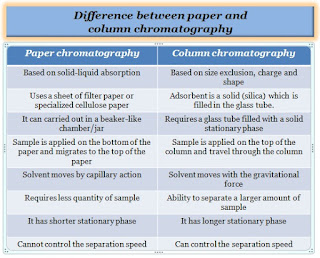
Difference between paper and column chromatography

The major difference between paper chromatography and column chromatography is that the stationary phase in paper chromatography is cellulose paper, and it is based on the solid-liquid adsorption and solubility of the compound, whereas in column chromatography, a column packed with a matrix is used as a stationary phase to separate molecules. This separation is based on their size, affinity, or charge.

Chromatography is a significant biophysical method that allows the separation, purification, and detection of the analytes of complex mixtures for quantitative and qualitative analysis. Paper chromatography and column chromatography are both used in the separation of components in chromatography.


What is paper chromatography?

Paper chromatography is a type of planar chromatography method in which a piece of specialized paper is used as the stationary phase to separate the analytes. The principle involved is partition chromatography, in which substances are distributed or partitioned between liquid phases.

One phase is the water held in the pores of the cellulose filter paper used, and the other is the mobile phase, which moves on the paper. During the movement of the mobile phase, the compounds in the mixture separate due to variations in their affinity towards the stationary phase and mobile phase solvents. This mobile phase travels through the pores in the paper under capillary action.

What is column chromatography?

In analytical chemistry, column chromatography is a type of chromatographic technique for separating a chemical compound from a mixture that has been dissolved in a liquid. It separates sample molecules based on the adsorption of compounds, which allows them to be separated into fractions as the compounds pass through the column at different rates.

This process can be used to purify materials that will be employed on a smaller or larger scale in future research. This technique is an example of adsorption chromatography in which the stationary phase or adsorbent is solid. Silica gel is the most frequent stationary phase for column chromatography, followed by alumina.

Difference between column and paper chromatography:


Difference between paper and column chromatography

  • Paper chromatography is based on solid-liquid absorption, whereas column chromatography is based on size exclusion, charge, and shape.
  • Paper chromatography uses a sheet of filter paper or specialized cellulose paper as a stationary phase, whereas in column chromatography the stationary phase or adsorbent is a solid (Silica) which is filled into the glass tube.
  • Paper chromatography can be carried out in a beaker-like chamber/jar, whereas column chromatography requires a glass tube filled with a solid stationary phase to perform the separation.
  • In paper chromatography, a mixture of the sample is applied on the bottom of the paper and migrates to the top of the paper, whereas in column chromatography, the mixture of the sample is applied on the top of the column and travels through the column. For both techniques, the sample needs to be dissolved in a suitable solvent.
  • The solvent in paper chromatography moves by capillary action, whereas the solvent in column chromatography moves with gravitational force.
  • To perform the separation, paper chromatography requires less solvent, whereas column chromatography requires a larger amount of solvent system.
  • Paper chromatography requires a smaller quantity of samples than column chromatography, which has the ability to separate a larger amount of samples.
  • Since the stationary phase of paper chromatography is shorter, the sample is quickly separated, whereas column chromatography takes more time to separate the analyte as its stationary phase is longer.
  • In paper chromatography, we cannot control the separation speed, whereas in column chromatography, we can control the separation speed by regulating the flow with a knob.
  • Paper chromatography does not allow us to collect the sample, whereas column chromatography allows us to collect various bands into a separate container.


Monday, February 7, 2022

Difference between phenolphthalein and methyl orange indicator

Phenolphthalein and methyl orange are acid-base indicators that are chosen based on the neutralization reaction that occurs, however they have some differences, lets check them.

The compounds that change color when exposed to acidic or basic solutions are called indicators. Color indicators are commonly used to measure pH and may be added to the reaction mixture to identify the titration endpoint/equivalence point.


Acid-base titration indicators:

Acid-base titrations employ pH chemical indicators that change color over a range of pH values, rather than a single pH value. Generally, we use phenolphthalein and methyl orange to determine the endpoints of acid-base titrations. The selection of a certain indicator for titration is decided based on a plot known as the pH curve, which is typical of a particular reaction.

Methyl orange indicator:

Methyl orange is a weak acid, a synthetic indicator that provides endpoints for a pH range of 3.1 to 4.4. Its color is yellow in weak acidic or basic conditions (pH>4.4) and turns red in a highly acidic environment (pH<3.1). Its color is orange in the detection range of 3.1 to 4.4 pH.

To indicate the equivalence point, when the pH of the solution falls into the detection range, its color changes from yellow to orange, and when the pH of the solution raises into the detection range its color is red to orange.

Phenolphthalein indicator:

Phenolphthalein is a weak acid, a synthetic indicator that provides endpoints for a pH range of 8.3 to 10. It is colorless in strongly acidic and weak basic conditions (pH<8.3), and it turns pink in the strong basic environment (pH>10). Its color is pale pink in the detection range (pH: 8.8 to 10).

To indicate the equivalence point, when the pH of the solution rises into the detection range the color changes from colorless to pale pink, and when the pH of the solution falls toward the detection range its color changes from pink to pale pink

Difference between phenolphthalein and methyl orange indicator:

  • Phenolphthalein is a colorless, weak acid that dissociates in water to form pink anions, while methyl orange is a weak acid that dissociates in water to form orange-neutral molecules.
  • Phenolphthalein is suitable for titration of a weak acid against a strong base, while methyl orange is a useful chemical indicator for titration of a weak acid against a strong base.
  • The pKa of phenolphthalein is 9.4, while the pKa of methyl orange is 3.5.
  • The phenolphthalein indicator has a pH range of 8.2 to 10.0, while the methyl orange indicator has a pH range of 3.1 to 4.4.
  • In terms of color change due to pH, phenolphthalein changes from colorless to pink at pH 8.2, while methyl orange changes at pH 4.
  • In acid, the methyl orange indicator turns red, while phenolphthalein remains colorless.
  • In a basic solution, methyl orange turns yellow, while phenolphthalein turns pink.

References:
  1. Wikipedia contributors. (2022, January 23). Phenolphthalein. In Wikipedia, The Free Encyclopedia. Available Here
  2. Wikipedia contributors. (2021, September 27). Methyl orange. In Wikipedia, The Free Encyclopedia. Available Here
  3. “Acid-Base Indicators.” Chemguide: Helping You to Understand Chemistry - Main Menu, Available Here

Tuesday, January 25, 2022

Difference between healthy food and junk food

The major difference between junk food and healthy food depends on the amount of calories, fat content, and manufacturing techniques.

Any material that is commonly eaten or drunk by living things is considered food. Food is a human being's primary source of energy and nutrients, and it is mainly derived from natural sources such as plants. Fats, proteins, carbs, and alcohol are the four primary food energy sources.

According to nutritionists diet is almost everything and today, everyone wants to stay fit, healthy, and strong although diet selection can be difficult, and it's hard to reconcile all the conflicting advice on what to eat for a balanced, healthy diet. So, let's study more about the differences between healthy and junk foods, along with some examples.

What is healthy food?

Foods that have high nutrition and have a positive effect on our general health are called healthy food. It includes many organic food options, such as natural food, whole foods, etc. It might be defined as any food that is high in fiber, vitamins, proteins, minerals, water, and other nutrients.

This type of food, especially natural food, is known to be beneficial for your health. As a result, nutritious food is the food that is high in nutritional content and helps you stay fit and healthy.

Some of the examples of healthy foods are as follows.

Almonds, avocados, beans, nuts, cashews, dry fruits, edible seeds, flax seeds, fresh fruits juice, fruits, fresh vegetable soup, grains, legumes, leafy vegetables, milk or dairy products, millets and quinoa, peanuts, pecans, probiotic-rich foods, pumpkin seeds, salads, sesame, sunflower seeds, vegetables, and walnut, etc.

What is junk food?

Junk food is processed food known as unhealthy food that is high in calories, sugar, salt, oil, and fat content however low in nutritional value. Junk/fast foods are more popular than nutritious foods since they are inexpensive, frequently available in markets, visually appealing to customers, particularly children’s, and convenient to carry anywhere.

Regular consumption can lead to an increase in excess fat, processed sugar, and simple carbohydrates, which can increase the risk of heart disease, obesity, and other chronic health problems.

Some of the examples of fast foods are as follows.

Burgers, candy, cakes, cheeseburger, cookies, fried chips, fried foods, full cream cheese, high sugar foods, high-calorie coffee, ice cream, mozzarella, oily snack foods, pastries, pizza, potato fries, processed food, processed meat, soft drinks, sweetened carbonated beverages, and white bread, etc.

Difference between healthy food and junk food:

Nutrient value:
Healthy foods are rich in nutrients such as fruits, vegetables, and beans are rich sources of antioxidants that are essential for your body, while junk foods are high in calories but lack important nutrients.

Fast food is high in fat, added sugars, and, refined grains all of which raise the energy calories per gram, whereas healthy foods such as whole grains, lean protein, fruits, vegetables, and low-fat dairy products have a lower energy density.

Effect on health:
Junk food is unhealthy food that increases the risk of obesity, heart disease, diabetes, certain types of cancer, high blood pressure, depression, kidney and liver disease, and other health problems, whereas healthy food provides the body with all of the essential nutrients it requires to stay healthy.

Addictive qualities:
Junk food is thought to have addictive tendencies because it is based on sugar and fat, whereas healthy food does not have any addictive tendencies because it contains containing vital nutrients.

Taste:
Junk foods are tastier and come in a wider range of flavors; manufacturers make them appealing, flavorful, and spicy, whereas many people refuse to eat healthy food because it does not appeal to them.

Time to prepare:
Junk food is prepared and served quickly, whereas healthy food takes longer to prepare and cook.

Availability of food:
Healthy homemade food often necessitates freshly prepared that does not last long, whereas fast food is readily available at the market or in stores 24/7, formulated to last long.

Comparison of cost and quality:
Fast food can be less expensive to produce as it uses cheap and unhealthy ingredients like unhealthy oils, artificial flavors, sugar, and preservatives, whereas healthy foods are more expensive as they are prepared with good quality whole, unprocessed ingredients which are nutrient-rich and sustainably sourced.

Consumption and usage:
According to studies, at least one out of every four people eats junk food daily because it is more tasty, attractive, inexpensive, readily available in markets, visually appealing to customers, particularly children's, convenient to carry anywhere (Office, school, picnic spots, etc.) and people don't have enough time to cook. This makes it a popular choice in comparison to healthy food.

Social and economic factors:
As compared to the healthy foods are junk food emotionally connected to people which provides more employment, this industry goes higher and higher in grows every year in the form of fast-food chains, industries, restaurants, canteen’s, online delivery options.

Similarity between healthy and junk food:

The major similarity between healthy and junk food is that they both are consumed for the same reasons i.e. to satisfy cravings, and both contain calories.


References:
  1. Wikipedia contributors. (2022, January 20). Junk food. In Wikipedia, The Free Encyclopedia, Available Here
  2. Sowmya Binu, (October 13, 2020) Junk food vs healthy food: Advantages, disadvantages and Healthier Food Choices, Available Here
  3. Naveen. (6 Aug. 2011) “Difference between Healthy Food and Junk Food.” Compare the Difference between Similar Terms. Available Here
  4. Book: Bhaskar, R., Ola, M., & Patil, P. H. (2012). Junk food: Impact on health. LAMBERT Academic Pub.

People also search:

Healthy food vs. junk food 10 lines
Difference between healthy food and junk food for class 4
Difference between healthy food and junk food essay
Junk food vs. healthy food ppt
Difference between healthy food and junk food for class 6
Difference between healthy food and junk food for class 5
Difference between healthy food and junk food for class 2
Healthy food vs. junk food chart
Saturday, November 27, 2021

Difference between primary and secondary standard solution

The major difference between a primary standard solution and the secondary standard solution is that primary solutions have higher purity and lower reactivity, whereas secondary solutions have a lower purity and higher reactivity.

Standardization of solutions is an analytical chemistry concept that is essential for the accuracy of titration. Standardization is a method of determining the exact concentration of the prepared solution by using the standard solution in the form of reference. Standard solutions have exactly defined concentrations, and we make them with standard substances.

It is required to all solutions should be standardized using a primary standard solution before they can be used in the titration process. This is because, even if you weigh the accurate quantity of the sample analyte needed to make a 0.1 molL-1 solution, the concentration may not be exactly it might be the presence of impurities or manual error.


However, because the primary standard solution's concentration is 99.9% accurate, hence, to determine the exact concentration of the prepared solution, you can titrate it against an appropriate primary reference solution. Primary standard solution and secondary standard solution are the two major types of standard solutions. Primary standards are used to standardize secondary standard solutions, while secondary standards are used for certain types of analytical experiments.

What is the primary standard solution?

The primary standard solution is a solution composed of primary standard substances. A primary standard is a high-purity substance (99.9%) that can be dissolved in a known volume of solvent to produce a primary standard solution. These substances are commonly used to determine the unknown concentration of a solution that is capable of reacting chemically with the primary standard.

Primary standards are highly pure and stable and have unique chemical and physical characteristics. Thus, we can prepare pure solutions with these chemicals. Primary standards are commonly employed in titrations and other analytical techniques to determine an unknown concentration of solutes.

Primary standard solution example:

Examples of primary standards for the titration of solutions, based on their high purity, are:
  • Standardization of sodium thiosulfate (Na2S2O3) solution with potassium bromate (KBrO3).
  • Sodium carbonate for the standardization of aqueous acids such as sulfuric acid (H2SO4), nitric acid (HNO3), and hydrochloric acid (HCl) solutions.
  • Zinc powder (Zn) is used to standardize EDTA solutions.
  • Sodium chloride (NaCl) is used as a primary standard for silver nitrate (AgNO3) reactions.
  • Sodium carbonate (Na2CO3), potassium dichromate (K2Cr2O7), and potassium hydrogen phthalate (KHP) are some examples of primary standards.

What is a secondary standard solution?

A secondary standard solution is a chemical term for a solution that is titrated with a primary standard solution to determine its concentration. The secondary standard solution is composed of secondary standard substances for the specific analytical experiment. We should use primary standards to determine the concentration of these solutions. These types of standard solutions can be used to calibrate analytical instruments.

However, compared to primary standards, the purity of secondary standard solution is low, and the reactivity is high. Therefore, these solutions are easily contaminated due to their strong reactivity. Anhydrous potassium permanganate and sodium hydroxide are two common hygroscopic examples. Sodium hydroxide (NaOH) is a common example of secondary standard.

Difference between primary and secondary standard solutions:

    Difference between primary and secondary standard solution
  • Primary standard solutions are made from primary standard substances, while secondary standard solutions are solutions prepared specifically for certain analysis.
  • Primary standard solutions are highly pure (about 99.9%), while secondary standard solutions are not.
  • Primary standards are less reactive or non-reactive, while secondary standards are more reactive compared to the primary standard.
  • Primary standard solutions are rarely contaminated due to their low reactivity, while secondary standard solutions are quickly contaminated due to their high reactivity.
  • Primary standards are non-hygroscopic, while secondary standards are slightly hygroscopic.
  • Primary standard solutions are applied to standardize secondary standards and other reagents, while secondary standard solutions are applied for particular analytical studies.
  • Primary standards are unaffected by atmospheric oxygen, while secondary standards are influenced by the atmosphere or /environment.
  • Primary standards have known formulas and molecular weights, while the concentration of secondary standards varies over time.


Frequently Asked Questions (FAQ):


What is a primary standard?
A primary standard is an extremely pure reagent, has a high molecular weight, indicates the number of moles in a substance, can be easily weighed, and is used to cause a chemical reaction with another compound. Reagents are often used to determine whether a solution contains a specific chemical i.e. sodium carbonate (Na2CO3), potassium hydrogen phthalate (KHP), and potassium dichromate (K2Cr2O7), etc.

What is a secondary standard?
A secondary standard is a substance whose active agent content has been determined using a primary standard as a comparison. A secondary standard is made in the lab for a specific analysis and is generally standardized against a primary standard. NaOH, HCL, H2SO4, KOH, and KMnO4, etc. are some of the examples of secondary standards.


References:
  1. A.I. Vogel, Text Book of Quantitative Inorganic Analysis
  2. Helmenstine, Ph.D. Anne Marie. “Learn About Primary and Secondary Standards in Chemistry.”
  3. Wikipedia contributors. "Standard solution." Wikipedia, The Free Encyclopedia. Wikipedia, The Free Encyclopedia, 16 Sep. 2021.
  4. Madhusha, November 07, 2017 Difference Between Primary and Secondary Standard Solution: Definition, Properties, Examples, https://pediaa.com/difference-between-primary-and-secondary-standard-solution/

You may also like this

Thursday, October 28, 2021

Difference between blue and red litmus paper

The major difference between red litmus paper and blue litmus paper is that their reaction to different pH values, the blue litmus paper reacts to acidic samples, while red litmus paper reacts to alkaline sample solutions.

Indicators are a particular type of chemical, which can change their color when changing pH. In chemistry there are several indicators are used such as universal indicator, pH paper, and litmus paper (blue or red), etc. these are the fastest and easiest way to determine pH.

Definition of litmus paper:

It is a type of paper, when it is immersed in a solution, it changes color according to the acidity of the solution.

What is litmus paper?

The litmus paper is an indicator which available as a paper strip and it is used to detect the acidic and basic of sample solutions. It is made by a mixture of water-soluble dyes which are absorbed into the filter paper strips.
Difference between blue and red litmus paper

There are two types of litmus paper available which are blue and red color. Alkalinity is measured using red litmus paper, while the acidity is measured using blue litmus paper.

Around 1300, a Spanish physician named Arnaldus de Villa Nova used litmus for the first time. From the 16th century onwards, the blue dye was extracted from lichens in the Netherlands.

The basic raw ingredients used to make litmus paper are lichens, wood cellulose, and adjunct compounds. Litmus paper is made of paper that must be free of pollutants, as this can affect the pH of the sample being tested.

Red litmus paper:

As the name suggests, red litmus papers are colored red. The red litmus paper becomes blue when contacting with the basic or alkaline sample, it is used only to test for basic pH level. It will remain red if it comes into contact with an acidic or neutral solution.

Blue litmus paper:

As the name suggests, blue litmus papers are colored blue. The blue litmus paper becomes red when contacting with the acidic sample, but, if a substance is basic or neutral, then it will remain blue. It is used only to test for acidic pH levels.

Difference between red and blue litmus paper:

  • The major difference between red litmus paper and blue litmus paper is that their reaction to different pH values, the blue litmus paper reacts to acidic samples, while red litmus paper reacts to alkaline samples.
  • Red litmus paper is used to test alkalinity, while blue litmus paper is used to test acidity.
  • The color of red litmus paper is red, while the color of blue litmus paper is blue.
  • When red litmus paper comes into contact with acid, it remains red; when blue litmus paper comes into contact with the base, it remains blue.
  • Red litmus paper remains red, while blue litmus paper remains blue when it comes in contact with a neutral substance.


What is the difference between the litmus paper and universal indicator?

The pH is a significant factor that determines whether a solution is acidic or alkaline. It measures the concentration of hydrogen ions (H +) in the solution. pH is measured using a variety of methods, which are chosen depending on the application. It includes pH meter, pH paper, and litmus paper (blue or red), and universal indicator, etc. These are the quickest and most simple ways to determine pH, and each has its own advantage.


What is litmus paper?

Litmus is a water-soluble mixture of various dyes which is extracted from lichens. It is absorbed onto filter paper to make one of the kinds of pH indicator, which is used to determine the acidity of the sample.

Litmus paper is used to perform the litmus test which determines whether the sample/substance is acidic or basic. It is available in two types of strips, which are red and blue, and works similarly to pH paper. The red litmus paper turns blue if the sample has an alkali, whereas in acids the blue litmus paper becomes red. In neutral, both litmus papers do not change their color if the sample is neutral.

What is a universal indicator?

A universal indicator is a mixture of dyes that begin with green color, but while added to a solution it changes color. The color that changes, not only specifies that the substance is acidic or basic, but it can show the position on the pH scale from 0 to 14. Colors ranging from yellow to red specify an acidic solution, blue to violet indicate alkali, and green indicates a neutral solution.

Difference between the litmus paper and universal indicator:

  • The major difference between the litmus paper and the universal indicator is that the universal indicators can change a range of various colors, so it is useful in determining the strength of an acid or base, while the litmus paper only gives you an indication of whether the substance is an acid or alkali; it doesn't tell us about the strength of the acid or the base.
  • Litmus paper is used in tests where only the acidic or basic nature of the substance is involved, while the universal indicator is used in tests were to know the pH of a substance.


Wednesday, October 27, 2021

Difference between pH meter and pH paper

The major difference between the pH meter and pH paper is that the pH paper used to determine the pH is not as accurate as a pH meter, which determines the exact pH of the sample.

The pH is an important factor that specifies the acidity or alkalinity of the solution it measures the hydrogen ions (H +) concentration in the solution. The pH determines by the various method in which the electrometric method and colorimetric method are used. Universal indicator, pH meter, pH paper, and litmus paper (blue or red), etc. are the fastest and easiest way to determine pH.

What is a pH meter?

The pH meter is an electronic apparatus that is utilized to determine the pH of the sample solution. It has an electrode (glass electrode or reference electrode) attached to the meter, which can usually measure the small voltage. Since, it is calibrated with standard buffer solutions such as pH 07, pH 04, and pH 09.20, it gives accurate results on a scale of pH 0 to 14.

It is also referred to as a potentiometric pH meter since it measures the difference in electric potential between a pH electrode and a reference electrode. Depending on the pH level, a color-changing indicator, pH paper, or litmus paper can be used to get an approximate pH of the sample. The precision of such types is limited, and it can be complex to interpret correctly and hence a pH meter is most widely used to determine the pH of a sample solution.

What is a pH paper?

A pH paper is a piece of paper that is used to determine the pH of a solution and comes as strips that are saturated with pH indicators. It changes color when it comes into contact with the sample solution being tested, according to the pH of the sample solution.

It is a quick, simple, and reliable way of measuring acidity or alkalinity. Usually, a drop of the solution can be placed on the pH strip or it is immersed in the solution to see the color change compared to the reference scale (01-14).

Difference between pH meter and pH paper:

  • The major difference between a pH meter and a pH paper is that the paper used to determine the pH is not as accurate as a pH meter, which determines the exact pH of the sample.
  • As the name suggests, a pH meter is an instrument while pH paper is a paper strip.
  • The digital pH meter records pH values continuously and repeatedly and even allows automatic recording of measurements, whereas the paper strip can be used for only one manual measurement.
  • A pH meter requires more sample quantity to immerse the electrode, while a pH paper requires only a drop to detect a color change.
  • A pH meter is an expensive method of determining the pH of any solution as compared to paper, while a pH paper is an economical method as compared to a pH meter.
  • The readings provide by a pH meter are accurate and reproducible, while test strip results can vary depending on how the strips are handled, Different people perceive colors differently and may interpret color comparison in different ways.
  • pH meter has a longer shelf life, whereas pH paper has a shorter shelf life, test strips contain reagents that degrade over time.
  • pH meters require regular maintenance and calibration, which is time and cost consuming, while pH paper saves time and cost.
  • A pH meter apparatus that can provide computerized digital data in the form of software or printers and is recommended for audit and regulatory compliance, whereas the results provided by strips are not acceptable for that purpose.
  • Generally, a pH Meter is chosen instead of a pH Test strip since a pH meter often gives better resolution than the pH strips, and it is normally considerably more exact and accurate than test strips.

Tuesday, October 26, 2021

Difference between pH paper and litmus paper

Solutions and chemicals are often categorized as basic, acidic, and neutral. These classifications are decided on the pH scale (pH 0 to 14). Acidic has a low pH value, basic has a high pH value, and neutral has around 7 pH. The measurement of pH is an important factor in every field. It is widely used in agriculture to maintain the quality of water, soil, and pesticides, as well as for medicinal, pharmaceuticals, research, production, and quality control since it affects most of the product and quality.

There are different types of methods are available to determine the pH value of the substance in which the electrometric and colorimetric methods are used. Some of the commonly used methods of pH determination are universal indicator, blue litmus paper, red litmus paper, and pH paper, etc.
Difference between pH paper and litmus paper

What is pH paper?

A pH paper is a piece of paper (indicator) that is used to determine the pH of a solution, which is come in the form of strips that have saturated with pH indicators. Thus whether acid or a base is present; pH paper can change its color according to the pH of the sample solution.

Generally, it is used by immersed in the solution, or a drop of the sample solution can be placed on the strip of pH to view the change of color. The color is compared to the reference scale (01-14) when a color change occurs. This method is used to find the pH of a solution.

What is litmus paper?

A litmus paper is a test strip that is used to determine whether a sample solution is acidic or basic. Litmus paper is devoid of impurities that can cause color change due to the pH of the solution. Lichen is the primary raw material used in the manufacture of litmus, and paper becomes pH activated after a lichen infusion.

Litmus paper comes in two types: red and blue. The color of red litmus turns to blue when a drop of basic solution is placed on it, and when a drop of a basic solution is added to blue litmus, its color does not change. The color of red litmus paper will not change if an acidic solution is dropped on it. On the other hand, a drop of acidic solution on blue litmus changes the color from blue to red. As compared with the pH paper, litmus paper is unable to provide an accurate pH value for a solution.

Difference between pH paper and litmus paper:

  • The major difference between the pH paper and litmus paper is that the litmus paper shows that the sample is acidic or basic or neutral, whereas the pH paper gives the exact value of pH.
  • The pH paper has a scale that ranges from 01 to 14 and is used to determine the acidity or alkalinity of a solution, whereas litmus paper gives and a rough idea of whether a sample solution is acidic or basic.
  • pH paper gives more accurate readings than litmus paper.
  • Depending on the pH of the solution, pH papers provide a range of different colors, whereas litmus paper only shows two colors, red or blue.
  • pH strips are thought to be more sensitive than litmus paper, as litmus paper cannot provide quantitative data.


FAQ (Frequently Asked Questions):


Which is more accurate pH paper or litmus paper?
pH paper gives more accurate results than litmus paper because pH paper can determine the pH range of the solution.

Why is universal pH paper better than litmus paper?
Because a universal pH paper may indicate a variety of colors based on the pH of the solution, hence it is useful for determining the acid or alkali strength.

Is pH paper litmus paper?
Litmus paper is a type of pH paper, both of which are used in different ways to determine whether a sample solution is acidic or basic.


Difference between pH paper and universal indicator

Generally, the blue litmus paper, red litmus paper, pH paper, universal indicators, and pH meter are used to determine the pH. The pH paper is an indicator that changes as per the substance, in which it is dipped, Although a universal indicator is a liquid/solution substance that is dropped into a sample and it changes the substance as per the pH (acidic or basic).

The range of pH is between the pH 0 to pH 14 scale, in which below pH 07 is considered as acidic, above pH 07-14 is considered basic and pH 07 is neutral, it depends on the concentration of hydrogen ions which present in the substance.

What is pH paper?

A pH paper is a piece of paper strips are saturated with a pH indicator, it is used to determine if a solution is basic, acidic, or neutral. It is determined by dipping a piece of paper in the solution and its color changes according to the pH.
The chemical flavin causes a pH paper to change color in different solutions. This anthocyanin molecule is soluble in water and changes color when exposed to different types of liquids.

What is a universal indicator?

A universal indicator is a combination of various indicators that displays a range of colors depending on the pH of any sample solution. It comes in two types: a liquid ethanol solution and a pH paper soaked in an indicator solution.

Difference between the pH paper and universal indicator:

The major difference between the pH paper and universal indicator is the pH paper gives the exact pH of the substance, whereas the universal indicator is used to find out whether it is acid or alkaline, or neutral.


FAQ (Frequently Asked Questions):


Is universal indicator and pH paper the same?
The universal indicator and pH paper both are different things; however, they are used for the same purposes, which interprets how acidic or basic a solution is.

Why pH paper is called a universal indicator?
pH paper is known as a universal indicator, as it exhibits diverse colors at various concentrations of hydrogen ions in a solution. A universal indicator may exist in paper form or as a solution.

What is the difference between a universal indicator and a pH meter?
A pH meter is a device that measures pH digitally using a probe (Electrode) and voltmeter, while a universal indicator is a mixture of color-changing indicators that represent the pH of a solution.