Showing posts with label Primary and secondary standard. Show all posts

Sunday, March 20, 2022

Characteristics of a good primary standard

High purity, ready and cheap availability, stability, non-toxicity, low hygroscopicity, and high equivalent weight are the properties of a good primary standard.

What is a standard?

Standards are materials that contain an exactly known concentration of a substance for use in quantitative analysis. A standard provides a reference that can be used to determine unknown amounts or calibrate analytical instruments. There are two types of analytical standards: primary standards and secondary standards.

What is the primary standard in chemistry?

In chemistry, a primary standard is an exceedingly pure substance (99.9% accurate), which is easy to weigh and gives an indication of the number of moles in a compound. They do not react with the components of the air and maintain their structure for a long period.

They have special chemical and physical properties and are very pure and stable. Primary standards are frequently used in titration studies and other analytical chemistry techniques to determine an unknown concentration of solute.
"A primary standard is a measurement used to calibrate working standards. A primary standard is chosen as of its precision and stability when exposed to other compounds. Metrics such as length, time, and mass can be used to measure primary standards"

Characteristics of the primary standard:


Properties of primary standard:
It has a high degree of purity
Has a non-toxic or low toxicity
It has low reactivity and high stability
Is affordable and easily available
It has a high equivalent weight
It has a high solubility
Not hygroscopic


Let’s get a detailed explanation of the characteristics of a good primary standard. A primary standard must meet the following requirements:

  • High purity:
It should be available in the purest form and also be preserved in a pure state.
  • High stability:
A primary standard must be highly stable. Less stable compounds do not act consistently, making them reactive and unsuitable for use as standards. Even during storage, the composition of a primary standard should remain consistent.
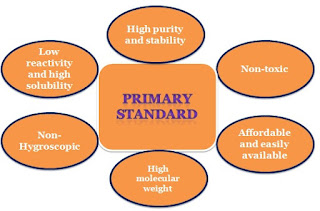
characteristics of primary standard
  • Non-toxic:
The standard should be a non-toxic chemical. Any material that is a nuisance or aesthetically ineffective and does not pose a health hazard is considered non-toxic.
  • Cheap in cost, and readily available:
The standard should be easily accessible and economical as it may usually be employed in a large amount.
  • Low reactivity:
The reactivity of the primary standard should be minimal. The results of chemical analysis are affected by reactive substances, which are not employed as primary standards.
  • Non-Hygroscopic:
The substance should be stable in the open atmosphere and unmodified in the air, i.e. during weighing.
  • High molecular weight:
The relative molecular weight of a primary standard should be high to reduce weighing errors.
  • Solubility:
It must be highly soluble in the solvent/ water to make the standard for further process.


Frequently Asked Question (FAQ): 

What are some examples of primary standards?
Potassium dichromate (K2Cr2O7), sodium chloride (NaCl), sodium carbonate (Na2CO3), and potassium hydrogen phthalate (KHP) are some of the examples of primary standards which are used in different types of titration.

What is a secondary standard?
A secondary standard is made in the lab for a specific analysis. In chemistry, it is usually standardized against the primary standard. Sodium hydroxide (NaOH) is an example of a secondary standard.


References:
  • Wikipedia contributors. "Primary standard." Wikipedia, The Free Encyclopedia. Wikipedia, The Free Encyclopedia, 26 Oct. 2021.
  • Helmenstine, Ph.D. Anne Marie. “Learn About Primary and Secondary Standards in Chemistry.”
  • Skoog, Douglas A., Donald M. West and F. James Holler. "Fundamentals of Analytical Chemistry 8th ed." Harcourt Brace College Publishers.


You may also like this:


    Wednesday, December 15, 2021

    Why is used or not used as a primary standard?

    Standards are substances that contain a known quantity of a drug and can be used to calculate unknown quantities or calibrate analytical instruments. Primary and secondary standards are the two types of standards available. Primary standards are used to standardize secondary standard solutions, while secondary standards are used for certain types of analytical experiments.

    In chemistry, a primary standard is a very pure reagent (99.9% accurate), easy to weigh, and offers an indicator of the number of moles in a molecule. A reagent is a material that is used to start a chemical reaction involving two or more components. To determine the amount of specific compounds in a sample solution, reagents are commonly used.

    Characteristics of a good primary standard:
    • It has a high degree of purity
    • Has a non-toxic
    • It has low reactivity and high stability
    • Is affordable and easily available
    • It has a high equivalent weight
    • It has a high solubility
    • In humid vs dry environments, it is unlikely to absorb moisture from the air to lessen mass fluctuations.

    Frequently Asked Question (FAQ):

    Is H2SO4 a primary standard?

    H2SO4 is hygroscopic, its concentration in the air often changes, and hence it is not used as a primary standard. H2SO4, HNO3, HCl, NaOH, and NH4OH are not considered primary standard solutions.

    Is NaOH a primary or secondary standard?

    NaOH is used as a secondary standard rather than a primary standard because sodium hydroxide is hygroscopic which attracts carbon dioxide (CO2), sulfur dioxide (SO2), and hydrogen sulfide (H2S), from the air and are reacted quickly with it.

    Why EDTA is not a primary standard?

    EDTA is a secondary standard, due to water content ambiguity, the hydrated sodium salt of EDTA (Na2H2Y.2H2O) cannot be used as the primary standard for titrations. This allows one to calculate the reagent's average molar mass and water content, allowing it to be used to make EDTA standard solutions.

    Why is HCl not used as a primary standard?

    HCL is a secondary standard, HCl cannot be obtained in high purity, it is not a solid at normal temperature and pressure, and its molecular mass is low. These are the three main reasons why HCl is not used as a primary standard.

    Why is K2Cr2O7 chosen as the primary standard?

    Potassium dichromate (K2Cr2O7) is used as the primary standard since it has high purity, high solubility has a higher molecular mass, can be accurately weighed, is stable in the atmosphere, is not hygroscopic, and react rapidly during the titration.

    Why is KIO3 a good primary standard?

    Potassium iodate (KIO3) is an oxidizing agent and a good primary standard. It is mainly used in the titration of thiosulfate and sulfite solutions as a stable source of iodine, which is liberated in the presence of the iodide ion and acid. It is pure enough to serve as a standard against which other reagents can be measured.

    Why is KMnO4 a self indicator?

    Potassium permanganate is a flexible and potent oxidant used in redox titration as a self indicator. KMnO4 has a unique value in that it works as a self-indicator. Titration of permanganate must be done in a heavy acid solution.
    Because KMnO4 is a redox indicator, Mn has a wide range of valencies. Mn's color varies when its valence state changes. As a result, no external indication is required potassium permanganate can serve as a self-indicator, indicating the endpoint of a reaction.

    Why is NaCl a primary standard?

    Sodium chloride is used as the primary standard because it is simple to obtain, has a high purity level, is inexpensive, has low reactivity (high stability), and does not decompose when heated. NaCl is used for silver nitrate (AgNO3) reaction as primary standards that meet all of the criteria of the primary standard. NaCl is hygroscopic, however when heated, it becomes stable, and it has high purity.

    Why is nitric acid not used in titration?

    Because nitric acid is a strong oxidizing agent it is not used in titration, in the redox titration, it will react with and consume some of the oxalate ions. As a result, less KMnO4 will be required to reach the endpoint in the presence of HNO3.

    Why oxalic acid is used as the primary standard?

    Oxalic acid is used as the primary standard as it is highly stable, pure, and does not change concentration due to environmental conditions. One issue with oxalic acid is that it can crystallize in two states: anhydric and dihydrate.

    Why is sodium thiosulfate not a primary standard?

    Because sodium thiosulfate (Na2S2O3) is hygroscopic, it is not used as a primary standard. When the humidity is high, the crystals absorb water, and when the humidity is low and the temperature is high, the water of crystallization is lost. As a result, we can't know a precise molecular weight without knowing the specific composition; hence a standard solution cannot be prepared without knowing the correct molecular weight.

    Why is sodium oxalate a good primary standard?

    Because of its high stability, non-toxicity, high molar mass, and readily available and inexpensive, disodium oxalate (Na2C2O4) can be used as a primary standard for standardizing potassium permanganate (KMnO4) solutions.

    Why is sulphuric acid not used as a primary standard solution?

    H2SO4 is not used as a primary standard solution because it doesn't fulfill the criteria for a primary standard as it absorbs moisture from the air. Sulphuric acid is available in the form of concentrated solutions that can be easily diluted; however, the concentration of the concentrated solution is unknown.

    Why K2Cr2O7 cannot be used as a self indicator?

    Because potassium dichromate can only work as an oxidizing agent in acidic media, it can't be employed as a self-indicator as its reduction product blocks the visual detection at the endpoint of the reaction.

    Why KMnO4 is not a primary standard?

    Potassium permanganate is secondary standard is not a primary standard because it is difficult to obtain the pure form as it is not free of MnO2. Furthermore, the color is so intense that it serves as its self indicator.

    Why sodium carbonate is a primary standard?

    Sodium carbonate is used as a primary standard in a different types of titrations, including acid-base titrimetry since anhydrous Na2CO3 is commercially available as an analytical reagent with a purity of 99.9% and is stable, so its strength does not fluctuate over time and its solution's molarity remains constant for a very long period.

    What is titration in chemistry and its types?

    Titration is a quantitative chemical analysis used to determine the concentration of a identified analyte. Titration is an important part of the study of chemistry. There are four types of titrations based on the chemical reaction that occurs between the titrant and the analyte: acid-base, redox, precipitation, and complexometric.


    Wednesday, December 1, 2021

    Why sodium hydroxide is not a primary standard

    The sodium hydroxide is cannot be used as a primary standard, mainly because NaOH is hygroscopic and absorbs carbon dioxide (CO2) from the air.

    Titration is a process in which a small amount of reagent is added to a solution until a chemical reaction (endpoint or equivalence point) occurs. The reaction confirms that the sample solution is at a certain concentration.


    We utilize standards that contain known amounts of analyte to standardize an analytical method. Standardization is a titration technique that uses a standard solution as a reference to determine the exact concentration of a prepared solution. In chemistry, standardization is a titration technique that uses a standard solution as a reference to determine the precise concentration of a prepared solution. Standard solutions are prepared using standard compounds and have concentrations that are accurately calculated.

    What is primary and secondary standard?

    The two most common forms of standard solutions are primary and secondary standard solutions. Primary standards are used to standardize secondary standard solutions, while secondary standards are used for certain types of analytical experiments.

    Primary standards are very pure (99.9% accurate), and stable, with specific chemical and physical properties. As a result, we can make pure solutions using these compounds. Titration and other analytical procedures often use primary standards to determine unknown concentrations of solutes. Common examples of the secondary standard are sodium carbonate (Na2CO3), potassium dichromate (K2Cr2O7), and potassium hydrogen phthalate (KHP), etc.

    The purity of the secondary standard solution is low, and the reactivity is high when compared to primary standards. Because of their high reactivity, these solutions are easily contaminated. A most common example of the secondary standard is sodium hydroxide (NaOH).

    A primary standard should have the following properties:

    • It must be very stable and non-toxic.
    • It should not decompose, absorb or react with moisture or air.
    • It must have a high degree of accuracy when weighing in the air or ambient temperature.
    • It should dissolve easily in water or any other solvent.
    • It must be available in a high purity state.

    Why is NaOH not a primary standard?

    Here are some most important reasons why solid NaOH is not used as a primary standard are mentioned.
    • Because NaOH does not fulfill all of the preconditions/ criteria/properties for a good primary standard that was described above, it is not a suitable primary standard.
    • When exposed to air for a few minutes, NaOH becomes very delinquent, meaning it gets watery.
    • Because specific components in ambient air, such as carbon dioxide (CO2), sulfur dioxide (SO2), hydrogen sulfide (H2S), and some other acid gases are reacted quickly with it and it also continues to attract moisture, becomes increasingly diluted over time.
    • NaOH solutions do not last long unless maintained under nitrogen since they absorb CO2 from the air very quickly, reducing the concentration.
    Why sodium hydroxide is not a primary standard

    Why KMnO4 is not used as a primary standard?

    Potassium permanganate is not used as the primary standard, because it is not free of MnO2, the pure form of KMnO4 is difficult to obtain, it decomposes in presence of sunlight, It reacts readily with any trace of organic matter or any other reducing substance in water, and its color is intense that it acts as its self indicator.


    Frequently Asked Questions (FAQ):


    Why is NaOH not used as a primary standard for titration analysis?
    The principle reason that NaoH is not used as the primary standard for titration is that the sodium hydroxide is highly hygroscopic and not available in high purity, it cannot be used to prepare primary standard titration solutions.

    Is H2SO4 a primary standard?
    No, sulfuric acid is not used as a primary standard because H2SO4 is hygroscopic, its concentration in air changes rapidly. Strong acids or bases, such as H2SO4, HCl, HNO3, NH4OH, and NaOH are not considered to be primary standard solutions.

    Why does sodium hydroxide have to be standardized?
    Before starting the titration, it is necessary to standardize the prepared molar/normal solution to determine the exact concentration.


    References:
    1. Wikipedia contributors. "Sodium hydroxide." Wikipedia, The Free Encyclopedia. Wikipedia, The Free Encyclopedia, 8 Nov. 2021.
    2. Helmenstine, Anne. ‘What Is a Primary Standard in Chemistry?’ Science Notes and Projects, 29 Mar. 2021, https://sciencenotes.org/what-is-a-primary-standard-in-chemistry/.
    3. Study.Com, https://study.com/academy/answer/1-sodium-hydroxide-cannot-be-used-to-prepare-a-primary-standard-titration-solution-because-the-compound-is-not-available-in-high-purity-the-most-common-impurity-is-water-because-sodium-hydroxide-is-h.html.

    Monday, November 29, 2021

    What is primary standard in chemistry?

    A primary standard is a highly pure reagent with a large molecular weight that can be easily weighed and used to initiate a chemical reaction with another component. 

    To standardize an analytical method we use standards that contain known amounts of analyte. Standardization is a technique in titration for establishing the exact concentration of a prepared solution by using the standard solution in the form of reference. The precision of standardization relies on the reagents and glassware used to prepare the standards. Standard solutions are made with standard components and have precisely determined concentrations.

    Standards are a substance that contains a known concentration of a drug and can be used to determine unknown amounts or calibrate analytical instruments. Analytical standards can be divided into two types, primary standards, and secondary standards.


    A primary standard is a highly pure reagent with a large molecular weight that can be easily weighed and used to initiate a chemical reaction with another component, while a secondary standard is a material whose active agent content was determined by comparing it to a primary standard.

    What is primary standard in chemistry?

    A primary standard in chemistry is an extremely pure reagent (99.9% accurate), easily weighed, and gives an indication of the number of moles in a compound. A reagent is a chemical that is used to initiate a chemical reaction between two or more substances. Reagents are frequently used to determine the presence or amount of specific chemicals in a sample solution.

    Primary standards are substances that do not react with the components of the air in the open state and retain their structure for a long time. They are extremely pure and stable, with specific chemical and physical properties.

    Primary standards are commonly used in experiments of titration and other analytical chemistry techniques to determine the unknown concentration of solute. Titration is a technique that involves adding a small amount of reagent to a solution until a chemical reaction happens (endpoint or equivalence point). The reaction confirms that the sample solution is at a certain concentration. There are four types of titrations: acid-base, redox, precipitation, and complexometric titration.

    Examples of the primary standard:

    • Potassium dichromate (K2Cr2O7) and sodium carbonate (Na2CO3), and potassium hydrogen phthalate (KHP)
    • In an acetic acid solution, potassium hydrogen phthalate can be used to standardize perchloric acid and an aqueous base.
    • The primary standard for silver nitrate (AgNO3) reactions is sodium chloride (NaCl).
    • Potassium dichromate (K2Cr2O7) is a primary standard for redox titrations
    • Sodium carbonate (Na2CO3) is a primary standard for the titration of acids
    • Potassium hydrogen iodate KH (IO3)2 is a primary standard for the titration of bases

    Why are primary standards used in chemistry?

    • A primary standard is a measurement used in the calibration of work standards. Because of its accuracy and stability when exposed to other compounds, a primary standard is chosen. Primary parameters can be measured as a metric, such as a length, mass, or time.
    • In analytical chemistry, it is commonly used. as, a reagent that is easy to weigh, a higher equivalent weight is selected, is pure and is not likely to change in weight when exposed to humid conditions, and has low reactivity with other chemicals.
    • The use of a primary standard ensures that the concentration of the unknown solution is accurate. Because of a process error, the degree of trust in the concentration is slightly lower. However, for some substances, this method of standardization is the most reliable technique to obtain a consistent concentration measurement.
    • Primary standards are generally used to make standard solutions that have an exactly known concentration. 

    Properties of primary standards:

    • They are unaffected by atmospheric oxygen
    • They have known molecular weight and method 
    • They are the dominant reactants
    • They are usually chemicals with a large molecular weight
    • Over a long period, they have a constant concentration/uniform composition

    The following are the characteristics of a good primary standard that provide more advantages:

    • It has a high degree of purity
    • Has a non-toxic
    • It has low reactivity and high stability
    • Is affordable and easily available
    • It has a high equivalent weight
    • It has a high solubility
    • In humid vs dry environments, it is unlikely to absorb moisture from the air to lessen mass fluctuations.
    In practical, some compounds used as primary standards achieve all of these requirements, although great purity is essential. Furthermore, a compound that is an excellent primary standard for one analysis may not be the best choice for another.

    What is a primary standard solution?

    A solution composed of primary standard compounds is known as a primary standard solution. A primary standard is a high purity (99.9%) material that can be dissolved in a known volume of solvent to form a primary standard solution. Zinc powder can be used to standardize EDTA solutions, after being dissolved in sulfuric acid (H2SO4), or hydrochloric (HCl) is an example of a primary standard solution.


    Frequently Asked Questions (FAQ):


    What is a secondary standard?
    A substance that has been standardized against a primary standard for use in a specific analysis is called a secondary standard. To calibrate analytical methods, secondary standards are often used. Sodium hydroxide (NaOH) is often employed as a secondary standard after its concentration has been confirmed using the primary standard.

    Why is the use of a primary standard solution important?
    Primary standards are necessary to determine unknown concentrations or to prepare working standards in titrations.

    What is the difference between primary and secondary standard?
    A primary standard is a reagent that can be easily weighed and is representative of the number of a substance contains, while a secondary standard is a substance that has been standardized against a primary standard for use in a particular analysis.


    References:
    1. Primary Standard Substance - QS Study. https://qsstudy.com/chemistry/primary-standard-substance. 
    2. Wikipedia contributors. "Primary standard." Wikipedia, The Free Encyclopedia. Wikipedia, The Free Encyclopedia, 26 Oct. 2021. 
    3. Helmenstine, Ph.D. Anne Marie. “Learn About Primary and Secondary Standards in Chemistry.”
    4. Skoog, Douglas A., Donald M. West and F. James Holler. "Fundamentals of Analytical Chemistry 8th ed." Harcourt Brace College Publishers.

    Saturday, November 27, 2021

    Difference between primary and secondary standard solution

    The major difference between a primary standard solution and the secondary standard solution is that primary solutions have higher purity and lower reactivity, whereas secondary solutions have a lower purity and higher reactivity.

    Standardization of solutions is an analytical chemistry concept that is essential for the accuracy of titration. Standardization is a method of determining the exact concentration of the prepared solution by using the standard solution in the form of reference. Standard solutions have exactly defined concentrations, and we make them with standard substances.

    It is required to all solutions should be standardized using a primary standard solution before they can be used in the titration process. This is because, even if you weigh the accurate quantity of the sample analyte needed to make a 0.1 molL-1 solution, the concentration may not be exactly it might be the presence of impurities or manual error.


    However, because the primary standard solution's concentration is 99.9% accurate, hence, to determine the exact concentration of the prepared solution, you can titrate it against an appropriate primary reference solution. Primary standard solution and secondary standard solution are the two major types of standard solutions. Primary standards are used to standardize secondary standard solutions, while secondary standards are used for certain types of analytical experiments.

    What is the primary standard solution?

    The primary standard solution is a solution composed of primary standard substances. A primary standard is a high-purity substance (99.9%) that can be dissolved in a known volume of solvent to produce a primary standard solution. These substances are commonly used to determine the unknown concentration of a solution that is capable of reacting chemically with the primary standard.

    Primary standards are highly pure and stable and have unique chemical and physical characteristics. Thus, we can prepare pure solutions with these chemicals. Primary standards are commonly employed in titrations and other analytical techniques to determine an unknown concentration of solutes.

    Primary standard solution example:

    Examples of primary standards for the titration of solutions, based on their high purity, are:
    • Standardization of sodium thiosulfate (Na2S2O3) solution with potassium bromate (KBrO3).
    • Sodium carbonate for the standardization of aqueous acids such as sulfuric acid (H2SO4), nitric acid (HNO3), and hydrochloric acid (HCl) solutions.
    • Zinc powder (Zn) is used to standardize EDTA solutions.
    • Sodium chloride (NaCl) is used as a primary standard for silver nitrate (AgNO3) reactions.
    • Sodium carbonate (Na2CO3), potassium dichromate (K2Cr2O7), and potassium hydrogen phthalate (KHP) are some examples of primary standards.

    What is a secondary standard solution?

    A secondary standard solution is a chemical term for a solution that is titrated with a primary standard solution to determine its concentration. The secondary standard solution is composed of secondary standard substances for the specific analytical experiment. We should use primary standards to determine the concentration of these solutions. These types of standard solutions can be used to calibrate analytical instruments.

    However, compared to primary standards, the purity of secondary standard solution is low, and the reactivity is high. Therefore, these solutions are easily contaminated due to their strong reactivity. Anhydrous potassium permanganate and sodium hydroxide are two common hygroscopic examples. Sodium hydroxide (NaOH) is a common example of secondary standard.

    Difference between primary and secondary standard solutions:

      Difference between primary and secondary standard solution
    • Primary standard solutions are made from primary standard substances, while secondary standard solutions are solutions prepared specifically for certain analysis.
    • Primary standard solutions are highly pure (about 99.9%), while secondary standard solutions are not.
    • Primary standards are less reactive or non-reactive, while secondary standards are more reactive compared to the primary standard.
    • Primary standard solutions are rarely contaminated due to their low reactivity, while secondary standard solutions are quickly contaminated due to their high reactivity.
    • Primary standards are non-hygroscopic, while secondary standards are slightly hygroscopic.
    • Primary standard solutions are applied to standardize secondary standards and other reagents, while secondary standard solutions are applied for particular analytical studies.
    • Primary standards are unaffected by atmospheric oxygen, while secondary standards are influenced by the atmosphere or /environment.
    • Primary standards have known formulas and molecular weights, while the concentration of secondary standards varies over time.


    Frequently Asked Questions (FAQ):


    What is a primary standard?
    A primary standard is an extremely pure reagent, has a high molecular weight, indicates the number of moles in a substance, can be easily weighed, and is used to cause a chemical reaction with another compound. Reagents are often used to determine whether a solution contains a specific chemical i.e. sodium carbonate (Na2CO3), potassium hydrogen phthalate (KHP), and potassium dichromate (K2Cr2O7), etc.

    What is a secondary standard?
    A secondary standard is a substance whose active agent content has been determined using a primary standard as a comparison. A secondary standard is made in the lab for a specific analysis and is generally standardized against a primary standard. NaOH, HCL, H2SO4, KOH, and KMnO4, etc. are some of the examples of secondary standards.


    References:
    1. A.I. Vogel, Text Book of Quantitative Inorganic Analysis
    2. Helmenstine, Ph.D. Anne Marie. “Learn About Primary and Secondary Standards in Chemistry.”
    3. Wikipedia contributors. "Standard solution." Wikipedia, The Free Encyclopedia. Wikipedia, The Free Encyclopedia, 16 Sep. 2021.
    4. Madhusha, November 07, 2017 Difference Between Primary and Secondary Standard Solution: Definition, Properties, Examples, https://pediaa.com/difference-between-primary-and-secondary-standard-solution/

    You may also like this