Monday, May 23, 2022

Precipitation titration: Principle, Example, Types, Indicators, Applications, and Importance

Learn about the principle, types, and applications of precipitation titration, which involves the formation of precipitate during the titration technique.

Chemical analysis plays an important role in the study of the composition of substances or materials. It is broadly divided into two types qualitative and quantitative analysis. Titration is also known as titrimetry or volumetric analysis. 

It is an analytical technique used to estimate the concentration of an analyte in a sample solution that is widely used in chemistry laboratories since it offers several applications and advantages.

Titration is carried out by using a burette containing a titrant with known concentration is placed above the conical flask or beaker of a solute. The titrant is added until the reaction is complete; the endpoint or equivalence point is usually indicated with an indicator. 

There are many different forms of titration such as acid-base titrations, redox titrations (oxidation-reduction), precipitation titrations, and complexometric titrations, in which each type involves a different type of chemical reaction.


What is precipitation titration with example?

Precipitation titration is a type of titration that involves the formation of a precipitate during the titration process. Precipitation titration refers to volumetric methods based on the formation of a slightly soluble precipitate, whereas the precipitating titration based on the use of silver nitrate (AgNO3) as a precipitating agent is known as the argentometric method.
Principle and types of precipitation titration

In a precipitate titration, the titrant reacts with the solute to produce an insoluble substance (precipitate). It continues until all of the solutes have been consumed in which uses silver ions to determine chloride levels. 

It is an important technique for determining halogens and certain metal ions. Precipitation titration is an important topic for class 12.

Precipitation titration example:

To estimate the chloride ion concentration in a sample solution, we can titrate it with a known concentration of silver nitrate solution.
The following chemical reaction takes place:
Ag+(aq) + Cl–(aq)→ AgCl(s).
  • During the titration, AgCl settles to the bottom of the conical flask in the form of a white precipitate.
  • The amount of silver ion used to reach the equivalence point is the same as the amount of chloride ion present at the start. The amount of silver ion used for the equivalence point is the same as the amount of chloride ion originally there.
  • Use n = cV to calculate the number of moles of silver or chloride ion.

What is the principle of precipitation titration?

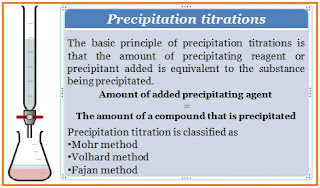
The basic principle of precipitation titrations is that the amount of precipitating reagent or precipitant added is equivalent to the substance being precipitated.

Amount of added precipitating agent = the amount of a compound that is precipitated

Precipitation titration curves:

The change in concentration of either a titrant or a titrand as a function of the titrant's volume is followed by a precipitation titration curve.
  • The precipitation titration curves are represented by:
  • During titration, the concentration of reactants changes
  • When using the indicators, there is a chance of titration error
  • The conditions at the equivalent point

Indicators used in precipitation titration:

For precipitation titration, there are three types of indicators are used, two of them are used chloride ions, while one is used cation silver.
  • In Mohr's titration, silver nitrate, or potassium chromate can use as an indicator to determine the concentration of chloride, which produces red silver chromate.
  • In Volhard’s titration, the ferric ion can use as an indicator to determine the silver ions, which produces red-brown color.
  • In Fajan’s titration, the dye dichlorofluorescein can use as an indicator to the determination of chloride, the endpoint being identified by the green suspension turning pink.

Determination of endpoint in precipitation titrations:

Ag+ titrations are known as argentometric titrations. To identification of endpoint in argentometric titration, three traditional methods based on color indicators can be used.
  • In Mohr's titration, the formation of colored precipitate at the endpoint
  • In Volhard’s titration, the formation of a soluble, colored complex at the endpoint
  • In Fajan’s titration, adsorption of a colored indicator on the precipitate at the endpoint

Types of precipitation titration:

There are three types of precipitation titration. According to the type of application and endpoint detection method, precipitation titration is classified as the Mohr method, Volhard method, and Fajan method.

Mohr method:

It is a type of precipitation titration used to determine the chlorides by titration with silver nitrate. It uses chromate ions (CrO42-) as the indicator, for the argentometric determination of bromide, cyanide and, chloride ions.

Volhard method:

The Volhard method is a type of precipitation titration to determine the bromine, chlorine, and iodine in the halide by precipitating it with excess silver nitrate and titrating the excess by addition with standard potassium thiocyanate (KSCN). It is performed in an acidic solution.

Fajan method:

It is a type of precipitation titration in which the reaction between the produced precipitate and the predictor is used in this method. Dichlorofluorescein is used as an indicator that acts as an anion in the solution.

Applications of precipitation titration:

  • Precipitation titration is most commonly applied for reactions where the titration cannot be recognized by changing the color.
  • The determination of halide ions or silver content using a sodium chloride (NaCl) solution is a typical use of precipitation titration.
  • The concentration of ions in the analyte sample can be determined using this method.
  • It is used to determine the salt content in water, food, and drinks, etc.
  • It has pharmaceutical applications also, such as analysis of carbromal, infusion of sodium chloride (NaCl), and potassium chloride (KCl) infusion, etc.

What is the importance of precipitation titration?

Precipitation titration is an important method in chemistry as it allows for an accurate determination of halogens and some metal ions concentration in the sample solution.


Sunday, May 15, 2022

Eriochrome black T indicator in complexometric titration

Complexometric titration or chelatometry is a type of volumetric analysis in which the endpoint is indicated by a colored compound. In several methods, EDTA can be used as a chelating titrant (a titrant is a solution whose concentration is known in a titration). Titration with EDTA can be performed in a variety of ways, including direct, back, replacement, and indirect titration.

Complexometric titrations are mainly employed to determine metal ions (calcium (Ca), zinc (Zn), magnesium (Mg), and other metal ions), using complex-forming processes.


What type of indicator is eriochrome black-T?

Eriochrome black-T is a type of complexometric indicator used in many titration reactions to change color from blue to pink.

What is the color of the EBT indicator?

EBT indicator comes in the form of dark red/brown powder with a molar mass of 461.381 g/mol. Eriochrome Black T is blue in its deprotonated form and when it forms a complex with calcium (Ca), magnesium (Mg), or other metal ions, it turns red. Compared to the EDTA–metal ion complex, the dye–metal ion complex is less stable.

What is the pH range of the EBT indicator?

The pH range of EBT is 7.0 to 11.0. It is a pH indicator (Metal indicator) that changes color from blue to pink when the pH changes. Its pKa values are 6.3 and 11.55.

Is EDTA a primary or secondary standard substance?

In general, EDTA is used as a secondary standard. The main reason a reagent is used as a secondary standard rather than as a primary standard is that it is not pure enough to be used as a primary standard.

Why is EBT used as an indicator?

Because it forms a complex with calcium, magnesium, and other metal ions in its protonated form, eriochrome black T is employed as an indicator in complexometric titration. Metal ions complexed with eriochrome black T react with EDTA to produce a blue solution with EDTA.

What is the role of eriochrome black T?

EBT is used as an indicator in complexometric titration, it is an azo-dye with two nitrogen atoms joined by a double bond. Eriochrome Black-T (EBT) acts as an acid-base indicator used to determine the hardness of water as well as metal ions. Eriochrome Black T forms complexes with both Ca2+ and Mg2+ ions, however, it binds to Mg2+ ions more strongly.

Eriochrome black t is also known as..

The complexometric indicator Eriochrome Black T is also known as Solochrome Black T which is the most commonly used indicator in EDTA titration. In an ammonia-ammonium chloride buffer solution at basic pH of 10, EBT is blue. When Ca2+ ions are added, it turns red.

Why EBT is used in EDTA titration?

Eriochrome black tea (EBT) is used as an indicator in EDTA titration which changes color from blue to pink at the endpoint when complex with calcium or magnesium.

Eriochrome black-T is used as a complexometric titration indicator because it forms a colored complex in its protonated form with calcium. This ability of EDTA to bind to metal ions is due to the lone pairs of electrons in its structure, which allow it to chelate the ions.

Which buffer solution is used before adding EBT?

In the complexometric titration, an ammonia buffer solution of pH 10 (mixture of ammonium chloride and ammonium hydroxide) is used. Because it resists pH changes, it is used in EDTA titrations. This is because all metal–EDTA reactions are pH-dependent.

How do you make an eriochrome black T indicator solution?

Take 01.00 gm of Eriochrome black T and pour in 80 ml of 95% ethanol, once it dissolves make up the volume to 100 ml.

What is the role of EBT in the hardness of water?

The indicator eriochrome black T (EBT) is used in the experiment to detect the presence of ions in the water sample. At pH 10, EBT complexes with metal ions form a wine red colored M-EBT complex.


Thursday, May 12, 2022

Estimation of hardness of water by EDTA method

Learn about the estimation of hardness of water by edta complexometric method through a laboratory experiment or practical.

Complexometric titration is also known as chelatometry titration, which is a type of volumetric analysis useful for determining different metal ions in which the formation of a colored complex detects the endpoint. Direct, back, and replacement titration are the types of complexometric titration.

Aim:

To determine the total hardness of the water sample by the EDTA complexometric titration.

Requirements for water hardness test:

Glasswares: Burette, burette stand, conical flask, volumetric pipette, beaker, volumetric flask, funnel, glass rod, wash bottle, etc.

Chemicals: LR grade ethylenediaminetetraacetic acid (C10H16N2O8), ammonia (NH3), hydroxylamine hydrochloride (HONH2•HCl), ethyl alcohol (C2H5OH), ammonium chloride (NH4Cl), magnesium bicarbonate (Mg (HCO3)2), and erichrome black-T indicator (C20H12N3O7SNa), etc.

Apparatus: Digital/analytical balance.

Suitable for test samples:

Drinking water, wastewater, cooling water, environmental water, raw water, process water, surface water, boiler water, etc.

Principle for estimation of hardness of water:

The hardness of water is due to the presence of dissolved calcium and magnesium salts. It is unsuitable for drinking, bathing, and washing, and causes scale formation in boilers. As a result, it is necessary to estimate the amount of hardness-causing chemicals in a water sample. Once determined, the amount of chemicals needed for water treatment can be calculated.

Using complexometric titration, the hardness is determined. The hardness of water is estimated by titrating with a standard solution of the complexing agent ethylene diamine tetra acetic acid (EDTA). As EDTA is insoluble in water, its disodium form is used in this experiment. EDTA can form four or six coordination bonds with a metal ion.

Total hardness:

The total hardness is caused by the presence of chlorides, bicarbonates, and sulphates of calcium and magnesium ions.

Temporary hardness:

Temporary hardness is caused by the presence of bicarbonates of magnesium and calcium ions. It can be easily eliminated through boiling.

Permanent hardness:

Permanent hardness is caused by the existence of sulphates and chlorides of magnesium and calcium ions. It cannot be eliminated through boiling.

Preparation of reagents:


Preparation of EDTA solution:

Take 04.00 gm of ethylenediaminetetraacetic acid and 0.1 gm of magnesium bicarbonate and dissolve them in 500 ml of distilled water in a volumetric flask, and properly mix it. Once it has completely dissolved, make up the volume to 1000 ml.

Preparation of eriochrome black-T indicator solution:

Take 0.4 gm of eriochrome black-T and 4.5 gm of hydroxylamine hydrochloride and dissolve them in 50 ml of 95% ethyl alcohol in a volumetric flask, and properly mix it. Once it has completely dissolved, make up the volume to 100 ml.

Preparation of ammonia buffer solution:

  • A: Take 16.9 gm of ammonium chloride and pour in 143.0 ml of ammonia solution.
  • B: Take 01.25 gm of magnesium salt of EDTA and dissolve it in 50 ml of distilled water.
Mix the A and B stock solutions and dilute to a volume of 250 ml with distilled water. Dilute 10.00 ml of the prepared solution with distilled water.

Procedure for determination of hardness of water by EDTA titration:

  • All glassware should be cleaned and dried according to standard laboratory procedures.
  • Before filling the burette for the titration, rinse it with distilled water and then pre-rinse it with a portion of the titrant solution. Pre-rinsing is required to make sure that all solution in the burette is the desired solution, not a contaminated or diluted solution.
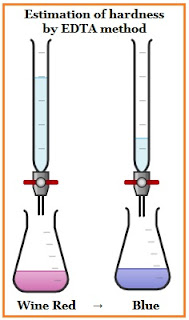
    Estimation of hardness of water by EDTA method
  • Take the standard EDTA solution (titrant) in a clean and dry beaker then fill the burette using the funnel.
  • Remove air bubbles from the burette and adjust the reading to zero.
  • Using a pipette, 50 ml of sample water and pour into a conical flask.
  • If the sample has a large amount of metal ions, use a lesser volume and dilute it to 50 ml.
  • Add 1ml prepared solution of ammonia buffer.
  • Then, add 2-4 drops of Eriochrome Black-T Indicator to this solution, which gives the solution a wine-red color.
  • Start the titration by adding EDTA drop by drop followed by stirring continuously, until the solution turns from wine red to blue color.
  • Repeat the titration three times to get accurate results, properly record the readings of the burette and calculate.
  • Take a 50.00 ml sample and boil it in another flask. (Add distilled water to get desired final volume).

Observation table:


Sr. No.

Content in conical flask


Burette reading

Volume of titrant used (ml)

Initial

Final

1


2


3


Mean:


Result:

The collected water sample contains total hardness = _____ppm


Wednesday, May 11, 2022

Why is EDTA used in the hardness of water?

Complexometric or chelatometric titration is a type of volumetric analysis in which the formation of a colored complex indicates the endpoint of a titration. Complexometric titrations are particularly useful for determining different metal ions. Direct, back, and replacements are types of complexometric titrations that are used for a variety of applications.

Why do we use EDTA in total hardness analysis of water?

Ethylenediaminetetraacetic acid (EDTA) is used to determine the total hardness concentration, as EDTA is capable of complexing with numerous metals in an ionic form that occurs in the water body. Using EDTA, the total hardness of water is determined mainly in terms of calcium carbonate (CaCO3) and magnesium carbonate (MgCO3), as these compounds are present in the highest amounts.

Using EDTA as the titrant, we titrate a water sample to quantitatively evaluate the total hardness of the water. This means that EDTA is poured drop-by-drop from the burette until the color of the indicator indicates the perfect endpoint of the reaction. Typically, an Eriochrome black T (EBT) indicator is used to determine the endpoint.

With the addition of a buffer solution with a pH of 10, fully deprotonated EDTA complexes with all metals at the end-point, to ensure that the EDTA has been completely deprotonated to complex with the various metal ions responsible for the hardness of the water. The ratio of the complexed metal to the fully deprotonated EDTA is 1, therefore stoichiometric calculations are conducted, which are simple to perform.


Tuesday, May 10, 2022

Buffer solution in EDTA complexometric titration

Complexometric titrations are volumetric titrations, also known as chelatometry, in which the endpoint is indicated by a colored complex. In this type of titration, an indicator capable of producing a distinct color change throughout the titration is used to identify the endpoint of the titration.

The concentration of metal ions in a solution is determined using complexometric titrations. During titration, the volume of the analyte, titrant, and even the indicator is important. Complexometric titration utilizes indicators such as Eriochrome black T or calcein.


Which buffer solution is used in EDTA titration?

An ammonia buffer solution is used in EDTA titration. The complexometric titration is performed at a pH 10 in an NH4Cl + NH4OH buffer, which maintains the EDTA mostly in its half-neutralized form. In general, we use ammonium chloride and ammonia buffer in EDTA titrations to determine the hardness of the water.

Why buffer solution is used in EDTA titration?

A buffer solution is used in EDTA titration as it is resistant to pH changes. All reactions between metal ions and EDTA are pH-dependent. Changes in pH can cause metal ions and EDTA to react improperly.

Why is pH 10 buffer used in EDTA titration?

There are two reasons to maintain the pH 10 of the EDTA titration buffer. The first reason is that all reactions between EDTA and metal ions are pH-dependent, and for divalent ions, the solution should be kept basic for the reactions to proceed. The second reason is that for a suitable color change, the eriochrome black–T or solochrome black-T indicator requires a pH of between 8 and 10.

How do you prepare an ammonia buffer solution for hardness?

To prepare ammonia buffer solution for hardness, in a volumetric flask, dissolve 5.40 grams of ammonium chloride and 35.00 ml of a 10M ammonia solution in 100 ml of distilled water and properly mixed it.

Why control of pH is necessary for complexometric titration?

A buffer solution must be used to maintain a constant pH throughout a complexometric titration. Controlling the pH is necessary because the H+ ion plays an important role in chelation. Most ligands are basic and bind to H+ ions over a broad pH range.

During chelate formation, the metal often displaces a portion of these H+ ions from ligands (chelating agents). During chelate formation, the metal often displaces some of these H+ ions from the ligands.

What is the role of pH in EDTA titrations?

In buffer solution, the metal ions to be measured EDTA titrations are performed. The stability constant of the metal–EDTA complex is dependent on the pH used. For example, metals with a low stability constant require an alkaline pH. Low alkaline to mildly acidic pH is necessary for metals with high stability constant.

The dissociation reactions of acid from EDTA and H4Y are also pH-dependent. pH is also a crucial criterion for the proper operation of the indicator substance. Consequently, it is important to maintain the pH throughout the EDTA titration.

What happens if pH is not maintained in complexometric titrations?

A change in pH may lead to an improper reaction between the metal ion and EDTA. A buffer solution must be adequately maintained for EDTA titration because all reactions between metal ions and EDTA are pH-dependent.

Why is pH 10 buffer solution added during the determination of the hardness of water?

As in the determination of water hardness, indicator EBT is used, which requires a pH of 8–10 for color change. So the buffer solution is needed to preserve the pH of the solution.


Saturday, May 7, 2022

Why does EDTA need to be standardized?

Complexometric or chelateometry titration is a type of volumetric analysis in which the formation of a colored complex is used to detect the titration’s endpoint. This type of titration is very effective for determining the concentration of a mixture of metal ions in the sample solution. The endpoint of the titration is usually detected using an indicator capable of producing a recognizable color change.

EDTA (ethylenediaminetetraacetic acid) is an aminopolycarboxylic acid that is a colorless, water-soluble solid. It has four carboxyl groups and two amine groups that can all act as electron pair donors or Lewis bases. etheylenediaminetetraacetic acid (EDTA) is a hexadentate ligand since it can donate its six lone pairs of electrons to form coordination covalent connections with metal cations.

Why is it necessary to standardize solutions of EDTA in complexometric titrations?

To determine the exact concentration (molarity or normality) of the prepared solution of EDTA it needs to be standardized before titration of the analyte. In a titration reaction, a known volume of titrant of known concentration (A) is added to an unknown quantity of reactant (B). We cannot calculate the molar equivalence without knowing A or B.

For example,
Metal ion + EDTA→ (Metal ion) EDTA.
Because [metal ion] + is unknown, there is no way to determine the amount present unless we know [EDTA] well. Therefore, to standardize and calibrate the titration, a known mass of primary standard is necessary.

Several reagents such as metallic magnesium, calcium carbonate, and metal bismuth can be used to standardize EDTA. Standardize the EDTA solution against the same cation and use the same method that can be used during sample analysis for optimal results.


Why is EDTA used in complexometric titration?

Complexometric titration also known as chelatometry is a type of volumetric analysis that uses the formation of a colored complex to identify the titration's endpoint. Complexometric titrations are very effective for determining the metal ions by use of complex-forming reactions.

The endpoint of the titration is commonly detected using an indicator such as Eriochrome Black T (EBT) capable of producing a noticeable color change. Direct titration, back titration, and displacement titration are the types of complexometric titration.

Why EDTA is used in complexometric titration?

Ethylenediaminetetraacetic acid (EDTA) has four carboxyl groups and two amine groups, all of which can behave as electron pair donors or Lewis bases. EDTA is a hexadentate ligand as it can donate its six lone pairs of electrons to form coordinate covalent connections with metal cations. In practice, however, EDTA is only partially ionized, forming less than six coordination covalent connections with metal cations. In an aqueous solution, EDTA forms an octahedral complex with the majority of 2+ metal cations, M2+.

The major reason why EDTA is widely used in the standardization of metal cation solutions is that most metal cation-EDTA complexes have a relatively high formation constant, which means that the equilibrium for the reaction M2+ + H4Y MH2Y + 2H is far to the right. 

Reacting in a basic buffer solution at pH 10.00 eliminates H+ as it allows the EDTA-metal cation complex to form the reaction product more easily. For most applications, the formation of metal cation EDTA complexes is considered complete, and this is what EDTA is mainly used for.

Why do we use only EDTA in complexometric titration and no other standard solutions what is the reason behind this?


EDTA is a hexadentate ligand that can easily form complexes/ chelates with practically any metal, and the stability is dependent on the pH of the solution so that titration can be performed preferentially in solution with one metal ion in the presence of the other.


Friday, May 6, 2022

Complexometric EDTA titration

Titration is a typical laboratory technique for determining the unknown concentration of an analyte that has been identified. When it comes to goals and processes, different types of titration are used, such as acid-base, precipitation, redox, and complexometric titration.

What is complexometric titration?

Complexometric titration, also known as chelatometry, is a method of volumetric analysis in which colored complexes are used to determine the endpoint of the titration. It is a quantitative chemical analysis approach that is used to quantify metal ions by employing complex-formation reactions.

In this type of titration, the metal ion reacts with the indicator to form the metal indicator complex in this type of titration. Consequently, ethylenediaminetetraacetic acid is introduced, which reacts with the metal ion to form the metal-EDTA complex, which is more stable than the metal-indicator complex.

Thus, the metal-indicator complex breaks down, releasing free metal ions to react with EDTA. Because free metal ions are not present at the equivalent point, the color of the free indicator ion differs from the color of the metal indicator complex.

What is EDTA titration?

EDTA (ethylenediaminetetraacetic acid) is a complexometric indicator made up of two amino groups and four Lewis bases (carboxyl groups). Because of its ability to denote six pairs of lonely electrons caused by the formation of covalent bonds, Edta is a hexadentate ligand.

The presence of even small metal ions will cause a noticeable color change. This results in the formation of a weak complex. The majority of complexing agents are free acids, which are less soluble in water. In volumetric solutions, they are used. They are converted into sodium salts that can be used in water before being used. They are used for titration because of their low solubility in water.
complexometric EDTA titration

Simple titration methods are sometimes used to determine the presence of simple metal ions in water. However, complexometric titration with EDTA is performed to identify the precise number of metal ions present in the sample.

How does EDTA complexometric titration work?

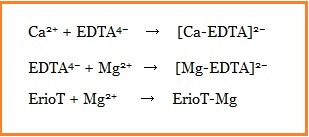
In water, EDTA or its sodium salt forms a stable complex ion with the hardness-producing ions Ca2+ or Mg2+. The titration is performed in the presence of an indicator like eriochrome black (EBT).

The total hardness of a hard water sample can be measured by titrating Ca2+ and Mg2+ contained in an aliquot of the sample with a Na EDTA solution, utilizing ammonium chloride (NH4Cl), a pH = 10 ammonia (NH4OH) buffer solution, and the metal indicator EBT. In hard water, the EBT indicator forms a wine-red, unstable combination with Ca2+ or Mg2+ ions at pH 10.

As EDTA from burette is added to the wine red complex, a more stable Ca-EDTA complex is formed, although it is colorless. When all Ca2+ ions have complexed with EDTA near the endpoint, indicator EBT ions break out, which turns the solution blue.

Indicator used in EDTA complexometric titration:

To determine the endpoint of metal cation titrations using EDTA, a complexometric indicator is required. For this purpose, a blue dye called Eriochrome Black T (EBT) is most commonly used as an indicator.

Organic dyes such as eriochrome black t, fast sulphon black, eriochrome red b, Patton Reeder, or murexide are common indications. When the endpoint is reached, the indicator is displaced from the metal cations in the solution, resulting in a color change. Thus, the free indicator acts as the endpoint indicator.

Types of EDTA titration:

EDTA titration is classified as direct, indirect, back, and displacement titration.

Direct titration:

The direct method of complexometric titration is the most basic titration process that involves the use of a metal-salt solution titrated with a complexing compound solution (Reaction between unknown compounds with a titrant of known concentration).

Indirect titration:

It involves the process of reacting the solute with moles of a particular excess reagent and thereby titrating this reagent with a second reagent. It applies to compounds having aluminum or bismuth or mercury.

Black titration:

It involves an excess of EDTA being added to the metal ion solution, and after that, the excess of EDTA being titrated with a known concentration of a second metal ion.

Displacement titration:

The excess second metal bound to EDTA is used to titrate the analyte. The second metal in the EDTA complex is displaced by the analyte ion.

Applications of EDTA titration:

  • It is used to determine how many metal ions are in a solution.
  • It is used to determine the hardness of the water.
  • It is used to determine the amount of calcium in food products.
  • It is used to find out how many harmful metals are in the environment.
  • It is used for the assay of different types of drugs, such as aluminum hydroxide.

Frequently Asked Question (FAQ):

Why do we use EDTA in titration to calculate hardness?

The hardness of an unknown water sample can then be determined using the EDTA solution. EDTA is added since is insoluble in water and it will complex to free Ca2+ and Mg2+ ions, leaving the MgIn– complex alone until almost all of the calcium and magnesium have been converted to chelates., hence the disodium salt of EDTA is taken for this experiment.

Why is EBT used in EDTA titration?

Because it forms a complex with calcium, magnesium, and other metal ions in its protonated form, eriochrome black T is used as a complexometric titration indicator. The metal ions complexed with eriochrome black T react with the EDTA to form a blue color when titrated with EDTA.

What is a complexometric titration example?

The estimation of water hardness using EDTA and Eriochrome Black-T as the indicator is one example of complexometric titration.


References:

Wednesday, May 4, 2022

Difference between paper and column chromatography

The major difference between paper chromatography and column chromatography is that the stationary phase in paper chromatography is cellulose paper, and it is based on the solid-liquid adsorption and solubility of the compound, whereas in column chromatography, a column packed with a matrix is used as a stationary phase to separate molecules. This separation is based on their size, affinity, or charge.

Chromatography is a significant biophysical method that allows the separation, purification, and detection of the analytes of complex mixtures for quantitative and qualitative analysis. Paper chromatography and column chromatography are both used in the separation of components in chromatography.


What is paper chromatography?

Paper chromatography is a type of planar chromatography method in which a piece of specialized paper is used as the stationary phase to separate the analytes. The principle involved is partition chromatography, in which substances are distributed or partitioned between liquid phases.

One phase is the water held in the pores of the cellulose filter paper used, and the other is the mobile phase, which moves on the paper. During the movement of the mobile phase, the compounds in the mixture separate due to variations in their affinity towards the stationary phase and mobile phase solvents. This mobile phase travels through the pores in the paper under capillary action.

What is column chromatography?

In analytical chemistry, column chromatography is a type of chromatographic technique for separating a chemical compound from a mixture that has been dissolved in a liquid. It separates sample molecules based on the adsorption of compounds, which allows them to be separated into fractions as the compounds pass through the column at different rates.

This process can be used to purify materials that will be employed on a smaller or larger scale in future research. This technique is an example of adsorption chromatography in which the stationary phase or adsorbent is solid. Silica gel is the most frequent stationary phase for column chromatography, followed by alumina.

Difference between column and paper chromatography:


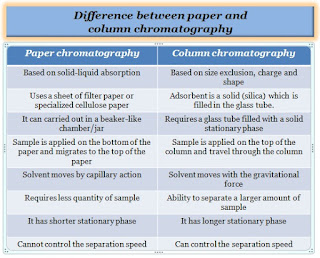
Difference between paper and column chromatography

  • Paper chromatography is based on solid-liquid absorption, whereas column chromatography is based on size exclusion, charge, and shape.
  • Paper chromatography uses a sheet of filter paper or specialized cellulose paper as a stationary phase, whereas in column chromatography the stationary phase or adsorbent is a solid (Silica) which is filled into the glass tube.
  • Paper chromatography can be carried out in a beaker-like chamber/jar, whereas column chromatography requires a glass tube filled with a solid stationary phase to perform the separation.
  • In paper chromatography, a mixture of the sample is applied on the bottom of the paper and migrates to the top of the paper, whereas in column chromatography, the mixture of the sample is applied on the top of the column and travels through the column. For both techniques, the sample needs to be dissolved in a suitable solvent.
  • The solvent in paper chromatography moves by capillary action, whereas the solvent in column chromatography moves with gravitational force.
  • To perform the separation, paper chromatography requires less solvent, whereas column chromatography requires a larger amount of solvent system.
  • Paper chromatography requires a smaller quantity of samples than column chromatography, which has the ability to separate a larger amount of samples.
  • Since the stationary phase of paper chromatography is shorter, the sample is quickly separated, whereas column chromatography takes more time to separate the analyte as its stationary phase is longer.
  • In paper chromatography, we cannot control the separation speed, whereas in column chromatography, we can control the separation speed by regulating the flow with a knob.
  • Paper chromatography does not allow us to collect the sample, whereas column chromatography allows us to collect various bands into a separate container.