Showing posts with label Advantages and Disadvantages. Show all posts

Monday, January 23, 2023

Advantages and disadvantages of healthy food

Healthy food is essential for human health, appearance and energy. This can help us reduce their chances of developing health problems. Healthy food is more beneficial for our health than junk food or fast food. 

If people make the right food choices and follow their diet consistently, it can be easy to maintain. There are several healthy food options available, and we should determine what works best for us.

What is healthy food?

Foods that are high in nutrition and benefit our overall health are called healthy foods. It offers a variety of organic food options, including natural foods, whole foods, and no processed food. Any food that is high in vitamins, fiber, minerals, carbohydrates, fats, proteins, water, and other nutrients can be considered healthy. 

Some examples of healthy foods are nuts, vegetables, fruits, milk or dairy products, peanuts, pecans, and walnut, etc.

Advantages of healthy food:

  • The major advantage of eating healthy food is that it contains high amounts of vitamins and minerals, which are essential for the human body to stay energized and avoid health problems. 
  • It provides the body with more energy and essential nutrients that it needs to function optimally.
  • Healthy foods contain antioxidants that help eliminate potentially damaging cells (Free radicals)
  • Like junk food and fast food, eating healthy (homemade) food we does not get addictive tendencies.
  • A healthy diet can reduce the chances of chronic health problems.
  • It helps in achieving and maintaining a healthy weight.
  • Eating a healthy diet rich in vegetables, fruits, whole grains and lean meats is an excellent way to maintain a healthy heart in general.
  • It helps the body function better.
  • It helps in keeping the digestive system functional and healthy.
  • Healthy food can boost your immune system and a strong immune system helps in keeping a person healthy.
  • It helps to regulate the blood sugar level in the body.
  • Healthy food contains vitamins and minerals that can improve the health of your hair, skin, and nails.
  • It can support brain development and keeps your mental health.
  • By eating healthy food, we can reduce the risk of heart disease, type 2 diabetes and some cancers.
  • It contains calcium, which is an essential mineral to build and maintain strong bones and teeth.
  • It supports healthy growth, body muscles, healthy pregnancies and breastfeeding.
  • It can help you sleep better, have more energy, and live longer.

Disadvantages of healthy food:

  • The major disadvantage of eating healthy food is that it can be expensive and take longer to prepare than junk or fast food. It is not possible for a person with little money to buy fresh fruits and vegetables regularly. Maintaining a healthy diet can be difficult over time.
  • People have a wide variety of healthy food choices, but it can be challenging to identify the ones that work best for their diet.
  • Since it is difficult to carry healthy food from home to work and other places, we depend on restaurants, or hotels, or street food. Therefore we become accustomed to dining outside.
  • Adapting to the changes brought about by healthy eating in our way of life can be very challenging. Some food cravings can be the result of long-term habits that are difficult to break.
  • Organic and chemical-free foods are becoming increasingly scarce in the market.
  • Healthy food like junk food may not always suit your taste buds, and this is the reason why people get bored after a while.
  • Healthy food does not have the same attractiveness, taste, variety, palatability and availability as junk food or fast food by which children’s or people attracted.
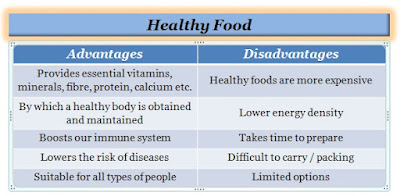
Advantages and disadvantages of healthy food


People also ask:

What are the negatives of healthy eating?
What are 3 challenges of eating healthy?
What are the advantages of healthy food?
10 disadvantages of healthy food
advantages and disadvantages of healthy food essay
advantages and disadvantages of healthy food and junk food
disadvantages of unhealthy food
what is healthy food
healthy food vs junk food 10 lines
advantages and disadvantages of junk food

Monday, December 6, 2021

Advantages and Disadvantages of Capsules

The major advantage of capsules is that its ability to act as an effective oxygen barrier and it is good chemical stability and helps increase product stability as well as is easy to swallow.

Dosage forms are pharmaceutical products that are specific combinations of drugs and excipients that can be formulated in a variety of ways, including solid, liquid, semi-solid, and gaseous dosage forms.

What is capsule dosage form?

A capsule is a form of solid dose in which the one or more active pharmaceutical ingredients (API) and excipients are enclosed in a hard or soft soluble shell, generally as gelatin. The shell is usually made of gelatin or other suitable polymeric substance, and this produces a simple, odorless, tasteless, elegant, and easy-to-swallow dosage form that does not require a further coating step.

Capsules are classed as either hard gelatin or soft gelatin depending on the nature of the capsule shell. Soft-shelled capsules are used for oils and medicines that are dissolved or suspended in oil, while hard-shelled capsules are used for dry, powdered ingredients.

A capsule is a common form of dose for oral administration, let's check some advantages and disadvantages of capsules.

Advantages of Capsules:

  • Capsules can mask the odor and taste of unpleasant medicines and can be simply administered
  • Easy to swallow with water
  • Fewer excipients are required than tablets.
  • Easily and rapidly digested
  • It's easy to handle and take
  • The capsule is economical than other dosage forms
  • The appearances of capsules are attractive
  • The gelatin shell can give protection of the drug from light
  • The shells of capsules are physiologically inert
  • It digested easily and quickly in the gastrointestinal tract
  • Capsules have a higher bioavailability than tablet dosage forms
  • It is easy to formulate and does not require any compression
  • A high degree of flexibility to the formulation

Disadvantages of Capsules:

  • Medicines that absorb water from the hygroscopic capsule shell make it brittle and therefore are not appropriate for the capsule filling
  • Concentrated solutions requiring previous dilutions are inappropriate for the capsule since irritation of the stomach
  • Not appropriate for highly efflorescent substances
  • For storage purposes, it required special conditions
  • It may cause gastric irritation
  • Components with low density, low melting point medication cannot be dispensed.
  • When compared to tablets, the production speed is slower
  • Gelatin-reactive materials cannot be dispensed
  • Materials that are reactive with gelatin cannot be dispensed
  • It may not be suitable for high-dose of drugs
  • Low density, low melting point components, and high dose drugs cannot be dispensed.
  • The speed of production is less as compared to tablets


Sunday, December 5, 2021

Advantages and disadvantages of gravimetric analysis method

 The gravimetric analysis is more advantageous if the protocols are followed carefully, it can produce extremely exact results.


To determine the amount of a certain component present in a sample, analytical techniques such as gravimetric, volumetric, and instrumental analysis are often used. We use a known amount of a known solute to quantify an unknown chemical in an analysis. This measurement can be expressed as volume or weight. When it is volume, we call it volumetric analysis, and when it is the weight we call it gravimetric analysis.

What is gravimetric analysis?

In analytical chemistry, gravimetric analysis is a type of quantitative analysis that is used to determine the mass of an unknown analyte in a sample. This technique uses the precipitation method to separate the compound from a sample, and they convert a dissolved substance (liquid) into a precipitate (solid) that can be weighed. Gravimetric analysis works on the principle of converting an ion, element, or radical into a pure stable state.

If the sample contains a mixture of solids, it must be dissolved in a suitable solvent before adding a reagent (precipitation agent) that will precipitate the particular component. Finally, filter the precipitate and weigh it. The determination of chloride in a chemical is one of the examples of gravimetric analysis.

The four basic types of gravimetric analysis are volatilization (physical gravimetry), precipitation, thermogravimetry, and electrodeposition (electrogravimetry), and these methods differ in sample preparation, before weighing the solute.

Advantages of gravimetric analysis:

  • When modern analytical balance is used in this method it is more exact.
  • It is an absolute method that requires no calibration and requires direct measurement.
  • It can produce extremely exact results if the protocols are followed carefully.
  • Filtrates can be evaluated for completeness of precipitation to identify potential sources of errors, and the presence of contaminants in precipitates could be examined.
  • Gravimetry has a minimal instrumental error and does not need the use of a series of standards to determine the unknown.
  • The gravimetric analysis was also used to determine the atomic masses of many elements in the periodic table with an accuracy of six figures.
  • The gravimetric method can be performed with a relatively inexpensive apparatus.

Disadvantages of gravimetric analysis:

  • The major disadvantage of the gravimetric method is that it takes a long time to complete.
  • Gravimetric analysis is typically limited to analyzing a single element or limited group of elements, at a time.
  • In today's world, chemists prefer this method.
  • These types of methods are usually complex, and even a slight mistake in a process can often mean disaster for the analysis.
  • Gravimetric analysis is based on mass measurement.


Frequently Asked Questions (FAQ):


What is meant by titration and types of titration?
A titration is a method of estimating the concentration of an unknown solution (Titrand) by comparing it to a known concentration solution (Titrant). Acid-base, precipitation, complexometric, and redox are the different types of titration.

What are the steps involved in gravimetric analysis
Preparation of the sample solution, precipitation process, digestion of the precipitate, washing and filtering the precipitate, drying, and ignition, weighing the precipitate are the major steps involved in this method.

What are the applications of gravimetric analysis?
It is used to determine the inorganic anions, cations, chloride, SO2, CO2, and iodine, etc. and it is also used to calibrate other instruments.


Referrences:

  1. Earnest, Charles M., and Larry Wilson. 2000. Quantitative Analysis: Gravimetric, Volumetric & Instrumental Analysis, 4th edition.
  2. Wikipedia contributors. "Gravimetric analysis." Wikipedia, The Free Encyclopedia. Wikipedia, The Free Encyclopedia, 31 Aug. 2021.
  3. Dhakatutor.com. “Advantages and Disadvantages of Gravimetric Method.” Dhakatutor.com, http://dhakatutor.com/article/view/16.

Monday, October 25, 2021

Advantages and disadvantages of glass electrode

The pH is the concentration of hydrogen ion in the sample, it is the most essential parameter for every solution and formulation. The pH value is significant in chemistry that is used to determine whether the sample is acidic, basic or neutral in nature. Basically, the pH value 07 is neutral, below pH 07 is acidic and 07 to 14 is basic in nature. The pH is measured by a device called pH meter, which contains electrodes, temperature sensors, and indicators or screen.


What is a glass electrode?

Advantages and disadvantages of glass electrodeA glass electrode is an ion-selective electrode made of a doped glass membrane that is sensitive to a specific ion. pH measurement is the most typical application for ion-selective glass electrodes. 

The pH electrode is an example of a hydrogen ion-sensitive glass electrode. Glass electrodes are an essential component in the instrumentation for chemical analysis and physicochemical research.

Advantages of glass electrode:

  • The glass electrode is most generally used where the chemical inertness is essential.
  • The glass electrode is very sensitive.
  • It is used for several kinds of applications.
  • Easy and convenient to use for cleaning and calibrating with a standard buffer solution.
  • It covers an acidic range and an alkaline range of pH.

Disadvantages of glass electrode:

  • Generally, the potential of the glass membrane depends on the pH.
  • It is tedious to accurately determine its single electrode capacity because it depends on many factors.
  • Deposits on the membrane of the electrode can disturb the pH measurement.
  • Probability of fragile glass breakdown.
  • The electrode is often needed to calibrate.
  • The special types of buffer solutions are necessary to calibrate.

Advantages of calomel electrode:

  • There is no need for a separate salt bridge because it already contains a side tube with a KCL (Potassium chloride) solution.
  • The electrode potential is repeatable and consistent.
  • They are convenient, compact, and relatively low cost.

Advantages of standard hydrogen electrode:

  • It may work as both an anode and cathode half cell.
  • Because a very minimal potential is created on the hydrogen electrode, its electrode potential can be taken to be zero.

Advantages of silver/silver chloride electrode:

  • It is simple and inexpensive to prepare.
  • Its results are stable and sturdy.
  • It covers a broad range of samples.