Sunday, January 16, 2022

Preparation of acetic acid solution

Learn how to make different concentrations of molar and normal acetic acid solutions, which are needed for many applications such as research, practical, pharmaceutical, chemical laboratory, and industries, etc.

Acetic acid is also known as ethanolic acid because it contains two carbon atoms.
The molecular weight of acetic acid (CHC3OOH) is 60.052 g/mol
The boiling point of acetic acid (CH3COOH) is 118 °C
The density of acetic acid (CH3COOH) is 1.05 g/cm³
The specific gravity of concentrated acetic acid (CH3COOH) is 1.055 g/ml
Generally, a liquid form of acetic acid (CH3COOH) in different concentrations is supplied in the market by vendors.

Requirements of glassware and apparatus:

Digital balance, beaker, pipette, pipette bulb, volumetric flask, measuring cylinder, glass rod, distilled water, AR/LR grade acetic acid, etc.

Calculation method:

Molarity = gram moles of the sample (CH3COOH) / volume of the solution

For example,
We calculate for the concentration of 0.1m acetic acid, for this purpose we can use acetic acid, glacial (99.5 %, 17.4 M). Acetic acid CH3COOH is monoprotic, therefore 0.1N = 0.1M.

We know the molar mass of acetic acid is= (12+3+12+32+1) = 60g/mol.

Molarity = gm moles of the solute (CH3COOH) / volume of the solution

0.1 x volume of the solution = gm moles of the solute (CH3COOH)
gm moles of CH3COOH = 0.1 x 1 = 0.1
gm moles of CH3COOH = gm moles of CH3COOH taken / mol. moles of CHC3OOH
gm moles of CH3COOH = 0.1 = gm of CH3COOH taken / 60.05
gm of CH3COOH taken =0.1 x 60.05
= 6.005 gm

The density of acetic acid is 1.049 g/ml, so 0.1 mol of HOAc (6.01 g) is 5.72 ml.
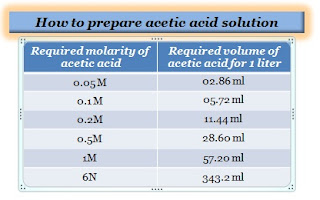
how to prepare acetic acid solution

How to prepare 0.05M acetic acid?

Take 02.86 ml of glacial acetic acid using a pipette, slowly and carefully dilute to 1000 ml of distilled water in a volumetric flask. Allow the solution to cool to ambient temperature and properly mix it.

How to prepare 0.1M acetic acid solution?

Take 6.005 gm (05.72 ml) of glacial acetic acid using a pipette, slowly and carefully dilute to 1000 ml of distilled water in a volumetric flask. Allow the solution to cool to ambient temperature and properly mix it.

How to prepare 0.2M acetic acid?

Take 11.44 ml of glacial acetic acid using a pipette, slowly and carefully dilute to 1000 ml of distilled water in a volumetric flask. Allow the solution to cool to ambient temperature and properly mix it.

How to prepare 250 ml of 0.25M acetic acid?

Take 03.58 ml of glacial acetic acid using a pipette, slowly and carefully dilute to 250 ml of distilled water in a volumetric flask. Allow the solution to cool to ambient temperature and properly mix it.

How to prepare 0.5M acetic acid?

Take 28.60 ml of glacial acetic acid using a pipette, slowly and carefully dilute to 1000 ml of distilled water in a volumetric flask. Allow the solution to cool to ambient temperature and properly mix it.

How to prepare 1M acetic acid?

Take 57.20 ml of glacial acetic acid, slowly and carefully dilute to 1000 ml of distilled water in a volumetric flask. Allow the solution to cool to ambient temperature and properly mix it.

How to prepare 2M acetic acid?

Take 114.40 ml of glacial acetic acid, slowly and carefully dilute to 1000 ml of distilled water in a volumetric flask. Allow the solution to cool to ambient temperature and properly mix it.

How to prepare 5N acetic acid?

Take 286.0 ml of glacial acetic acid, slowly and carefully dilute to 01 liter of distilled water in a volumetric flask. Allow the solution to cool to ambient temperature and properly mix it.

How do you make a 6N solution of acetic acid?

Slowly and carefully dissolve 360 g or 343.2 ml of acetic acid in 1 liter of water to make a 6N solution.

How do you make a 2% dilute acetic acid solution?

Take 02.00 ml of glacial acetic acid using a pipette, slowly and carefully dilute to 100 ml of distilled water in a volumetric flask, and properly mix it.

How do you make a 5% dilute acetic acid?

Take 05.00 ml of glacial acetic acid using a pipette, slowly and carefully dilute to 100 ml of distilled water in a volumetric flask, and properly mix it.

How to prepare 10% acetic acid?

Take 10.00 ml of glacial acetic acid using a pipette, slowly and carefully dilute to 100 ml of distilled water in a volumetric flask, and properly mix it.

How to prepare 100 mM acetic acid (sodium) buffer solution (pH=4.7)?

Take 02.87 ml of glacial acetic acid (99.5 %, 17.4 mol/L) and 06.80 gm of sodium acetate trihydrate (M.W.=136.08) and carefully dilute to 500 ml of distilled water in a volumetric flask. Once it has completely dissolved, make up the volume to 1000 ml.


Note:

  • Acetic acid is an extremely dangerous acid upon contact. Therefore follow laboratory safety measures (SOP) and please use extreme caution when preparing the solution concentrations.
  • When making acid solutions, it is recommended that always add (gradually) acid to water.
  • Stir a little amount of acetic acid into a large volume of water at a time, and then dilute the solution.
  • When handling acetic acid, always wear a chemical-resistant apron, gloves, and goggles to protect your eyes and skin.
  • Since fumes of concentrated acetic acid are toxic when inhaled, they should always be handled in a fume hood.
  • Acid should be kept in a special cabinet made of wood. Since metal corrode rapidly when exposed to hydrochloric acid vapors, wooden cabinets are better than metal cabinets for acid storage.
  • If acid splashes on your skin or in your eyes, wash it off with water for 15 to 20 minutes.

References:

Friday, January 14, 2022

Preparation of hydrochloric acid solution

Learn how to make different concentrations of molar and normal hydrochloric acid solutions, which are needed for many applications such as research, practical, pharmaceutical, chemical laboratory, and industries, etc.


The molecular weight of HCl is 36.458 g/mol
The boiling point of HCl is -85.05 °C
The density of HCl is 1.49 kg/m³
The specific gravity of HCL is 1.19 g/ml

Generally, a liquid form of hydrochloric acid (HCl) in different concentrations is supplied in the market by vendors.

Requirements of glassware and apparatus:

Digital balance, beaker, pipette, pipette bulb, volumetric flask, measuring cylinder, glass rod, distilled water, AR/LR grade hydrochloric acid (HCl), etc.

Normality is a measure of concentration that is equal to the gram equivalent weight of solute per liter of solution. Gram equivalent weight is a measure of the reactive capacity of a molecule. Normality is used to measure the concentration of acid or base in the solution. Unit of normality is Eq/L.

For example,

1M hydrogen chloride provides 1M hydrogen ions and 1M chloride ions into the solution. 1M of hydrogen ions is equal to one equivalent of hydrogen ions. 1M HCl is equivalent to 1N HCl because HCl is a monobasic acid, It has the same molecular mass and equivalent mass.

To make a 0.1 M HCl solution, we usually need to dilute it with water from a stock solution or concentrated HCl. Most concentrated hydrochloric acid is present in 37.5%. There are several methods for calculating; of these, we can use the most precise method, which is the normality calculation for dilution.

Calculation method:

Grams of compound required = (N desired) (equivalent mass) (desired volume in liters)
Volume of concentrated acid required = (grams of acid required)/ (% concentration x specific gravity).

We must first determine the normality before diluting 0.1 M HCl from a 37.5 percent concentrated HCl solution. Simply multiplying 0.1 M by 1 will give 0.1 N.

Equivalent mass is the molar mass divided by the number of hydrogen ions. HCl has a molar mass of 36.4611 g/mol. It’s because it only has one hydrogen ion.

Enter the details in the formula:-
Grams of compound required = (0.1 N) (36.4611)(1 Liter) = 3.6461
Volume of concentrated acid required = (3.6461)/(0.375 x 1.189) = 8.1774 ml
Therefore, 8.1774 ml of 37.5% concentrated hydrochloric acid is required to prepare 0.1 M HCl.

How to prepare 0.01N HCl solution?

Take 0.818 ml of 37.5% hydrochloric acid using a pipette, dilute to 1000 ml of distilled water in a volumetric flask. Allow the solution to cool to ambient temperature and properly mix it.

How to prepare 0.05N HCl solution?

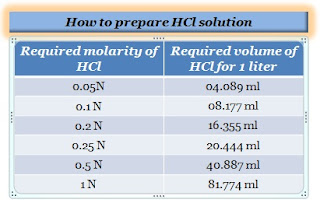
Take 04.089 ml of 37.5% hydrochloric acid using a pipette, dilute to 1000 ml of distilled water in a volumetric flask. Allow the solution to cool to ambient temperature and properly mix it.

How to prepare 0.1N HCl solution?

Take 8.177 ml of 37.5% hydrochloric acid using a pipette, dilute to 1000 ml of distilled water in a volumetric flask. Allow the solution to cool to ambient temperature and properly mix it.

How to prepare 0.2N HCl solution?

Take 16.355 ml of 37.5% hydrochloric acid using a pipette, dilute to 1000 ml of distilled water in a volumetric flask. Allow the solution to cool to ambient temperature and properly mix it.

How to prepare 0.25N HCl solution?

Take 20.444 ml of 37.5% hydrochloric acid using a pipette, and slowly dilute to 01 liters distilled water in a volumetric flask. Allow the solution to cool to ambient temperature and properly mix it.

How to prepare 0.5N HCl solution?

Take 40.887 ml of 37.5% HCL using a pipette, and slowly dilute to 01-liter distilled water in a volumetric flask. Allow the solution to cool to ambient temperature and properly mix it.

How to prepare 1N HCl solution?

Take 81.774 ml of 37.5% HCL, and slowly dilute to 1000 ml of distilled water in a volumetric flask. Allow the solution to cool to ambient temperature and properly mix it.

2N hydrochloric acid solution preparation:

Take 16.35 ml of 37.5% HCL using a pipette, and carefully dilute to 100 ml of distilled water in a volumetric flask. Allow the solution to cool to ambient temperature and properly mix it.

5N hydrochloric acid solution preparation:

Take 40.88 ml of 37.5% HCL, carefully dilute to 100 ml of distilled water in a volumetric flask. Allow the solution to cool to ambient temperature and properly mix it.

6N hydrochloric acid solution preparation:

Take 122.66 ml of 37.5% HCL, carefully dilute to 250 ml of distilled water in a volumetric flask. Allow the solution to cool to ambient temperature and properly mix it.

How to prepare 0.1 N HCl from 1 N HCl?

Using a pipette, dilute 10.00 ml of prepared 1N HCl solution to 100 ml of water in a volumetric flask, the resulting solution is 0.1N hydrochloric acid.

How to prepare 1 m HCl from 37.5% HCl?

Using a pipette, dilute 08.18 ml of 37.5% HCl to 100 ml of water in a volumetric flask, the resulting solution is 0.1M hydrochloric acid.

How to prepare 10 HCl from 36.5 % HCl solution?

We can calculate it by using the following formula i.e. C1V1=C2V2,
V1= 10*100/36.5=27.39 ml

Using a pipette, carefully dilute 27.39 ml of 36.5% HCl to 100 ml of water in a volumetric flask, the resulting solution is 10% hydrochloric acid.

How to prepare HCl solution

Note:

  • Hydrochloric acid is an extremely dangerous acid upon contact. Therefore follow laboratory safety measures (SOP) and please use extreme caution when preparing the solution concentrations.
  • When making acid solutions, it is recommended that always add (gradually) acid to water.
  • Stir a little amount of HCl into a large volume of water at a time, and then dilute the solution.
  • When handling HCl, always wear a chemical-resistant apron, gloves, and goggles to protect your eyes and skin.
  • Since concentrated hydrochloric acid is toxic when inhaled, it should always be handled in a fume hood.
  • Acid should be kept in a special cabinet made of wood. Since metal corrode rapidly when exposed to hydrochloric acid vapors, wooden cabinets are better than metal cabinets for acid storage.
  • If acid splashes on your skin or in your eyes, wash it off with water for 15 to 20 minutes.


References:

  1. Indian Pharmacopoeia 1996
  2. Wikipedia contributors, 'Hydrochloric acid', Wikipedia, The Free Encyclopedia, 13 January 2022, 18:16 UTC, Available Here
  3. ‘Use of Sulfuric Acid & Phosphoric Acid in Titration’. Sciencing, Available Here
  4. What Is the Difference between Molarity and Normality? Westlab. Available Here
  5. Acid & Base Normality and Molarity Calculator. Available Here
Wednesday, January 12, 2022

Preparation of sodium hydroxide solution

Learn how to make different concentrations of molar and normal sodium hydroxide solutions, which are needed for many applications such as research, practical, pharmaceutical, chemical laboratory, and industries, etc.


The molecular weight of NaOH is 39.997 g/mol.
The melting point of sodium hydroxide is 318 °C.
The boiling point of sodium hydroxide is 1,388 °C.
The density of NaOH is 2.13 g/cm³.
Generally, a solid form of sodium hydroxide (NaOH) in different grades is supplied in the market by vendors.

Requirements of glassware and apparatus:

Digital balance, beaker, pipette, pipette bulb, volumetric flask, measuring cylinder, glass rod, distilled water, and AR/LR grade sodium hydroxide (NaOH), etc.

Table of Contents:

  1. Prepare 0.05N NaOH
  2. Prepare 0.1N NaOH
  3. Prepare 0.2N NaOH
  4. Prepare 0.25N NaOH
  5. Prepare 1N NaOH
  6. Prepare 2N NaOH
  7. Prepare 5N NaOH
  8. Prepare 0.05 M sodium hydroxide
  9. Prepare 0.1 M sodium hydroxide
  10. Prepare 0.25 M sodium hydroxide
  11. Prepare 0.5 M sodium hydroxide
  12. Prepare 1 M sodium hydroxide
  13. Prepare 2 M sodium hydroxide
  14. Prepare 10% sodium hydroxide


Normality Equation:

The equation for normality is easy to understand if you have understood the gram equivalent weight.

Normality (N) = m /V × 1 / Eq

m is mass of solute in grams
V is total volume of solution in Liters
Eq is equivalent weight

Normality calculation of NaOH:

To prepare various concentrations of solution we can use this calculation, and we will use one example to help you understand how to make various concentrations.

Example:
How do you make a 1N NaOH solution?

Normality (N) = m /V × 1 / Eq
N = 1
m = unknown
V = 1 liter
Eq = 40.00g/

1 N = m /1L*× 1* / 40.00 g/eq

Using algebra and remembering that N is in eq/L:
m = 1 eq/L × 1 L × 40.00 g/eq ; hence m = 40 g
To prepare a 1N NaOH, 40 gm of sodium hydroxide are dissolved in one liter of distilled water.
Likewise, for a 0.1 N NaOH solution, divide by a factor of 10 and 4 grams of NaOH per liter is needed.
The terms molar and normal of NaOH are same, because NaOH has a valence of 1, 1 mole of NaOH in 1 liter of pure water = 1 N.

How to prepare 0.05N NaOH solution?

Weigh accurately 02.00 gm of sodium hydroxide and dissolve in 500 ml of distilled water in a volumetric flask. Once it has completely dissolved, allow the solution to cool to ambient temperature and make up the volume to 1000 ml with distilled water, and properly mix it.

How to prepare 0.1N NaOH solution?

Weigh accurately 04.00 gm of sodium hydroxide and dissolve in 500 ml of distilled water in a volumetric flask. Once it has completely dissolved, allow the solution to cool to ambient temperature and make up the volume to 1000 ml with distilled water, and properly mix it.

How to prepare 0.2N NaOH solution?

Weigh accurately 08.00 gm of sodium hydroxide and dissolve in 500 ml of distilled water in a volumetric flask. Once it has completely dissolved, allow the solution to cool to ambient temperature and make up the volume to 1000 ml with distilled water, and properly mix it.

How do you make 0.25N NaOH solution?

Weigh accurately 10.00 gm of sodium hydroxide and dissolve in 500 ml of distilled water in a volumetric flask. Once it has completely dissolved, allow the solution to cool to ambient temperature and make up the volume to 1000 ml with distilled water and properly mix it.

How to prepare 1N NaOH solution?

Weigh accurately 40.00 gm of NaOH and dissolve in 500 ml of distilled water in a volumetric flask. Once it has completely dissolved, allow the solution to cool to ambient temperature and make up the volume to 1000 ml with distilled water and properly mix it.

How to prepare 100 ml of 2N NaOH solution?

Weigh accurately 08.00 gm of sodium hydroxide and dissolve in 100 ml of distilled water in a volumetric flask. Once it has completely dissolved, allow the solution to cool to ambient temperature before use.

How to prepare 5N sodium hydroxide solution?

Weigh accurately 50.00 gm of NaOH and slowly dissolve in 250 ml of distilled water in a volumetric flask. Once it has completely dissolved properly mixing it and allow the solution to cool to ambient temperature before use.

Prepare NaOH solution

How to prepare 0.05 M sodium hydroxide?

Weigh accurately 02.00 gm of NaOH and dissolve in 500 ml of distilled water in a volumetric flask. Once it has completely dissolved, allow the solution to cool to ambient temperature and make up the volume to 1000 ml with distilled water, and properly mix it.

How to prepare 0.1 M sodium hydroxide?

Weigh accurately 04.00 gm of NaOH and dissolve in 500 ml of distilled water in a volumetric flask. Once it has completely dissolved, allow the solution to cool to ambient temperature and make up the volume to 1000 ml with distilled water, and properly mix it.

How do you make 0.25 M sodium hydroxide?

Weigh accurately 10.00 gm of NaOH and dissolve in 500 ml of distilled water in a volumetric flask. Once it has completely dissolved, allow the solution to cool to ambient temperature and make up the volume to 1000 ml with distilled water, and properly mix it.

How to prepare 0.5 M sodium hydroxide?

Weigh accurately 20.00 gm of NaOH and dissolve in 500 ml of distilled water in a volumetric flask. Once it has completely dissolved, allow the solution to cool to ambient temperature and make up the volume to 1000 ml with distilled water, and properly mix it.

How to prepare 1 M sodium hydroxide solution?

Weigh accurately 40.00 gm of sodium hydroxide pellets and dissolve in 800 ml of distilled water in a volumetric flask. Once it has completely dissolved, allow the solution to cool to ambient temperature and make up the volume to 01 liters with distilled water and properly mix it.

How to prepare 2 M sodium hydroxide?

Weigh accurately 80.00 gm of NaOH and dissolve in 1000 ml of distilled water in a volumetric flask. Once it has completely dissolved, allow the solution to cool to ambient temperature before use.

How do you make a 10% NaOH solution?

Weigh accurately 10.00 gm of NaOH and dissolve in 100 ml of distilled water in a volumetric flask. Once it has completely dissolved, properly mix it.


Note:
  • Sodium hydroxide is hygroscopic in nature it should be stored in a tightly closed container.
  • Stir a little amount of sodium hydroxide into a large volume of water at a time, and then dilute the solution.
  • When making sodium hydroxide solutions, it is recommended that always use distilled water.
  • Do not come into contact with sodium hydroxide! It's caustic and can result in chemical burns. Therefore should be handled with care, follow laboratory safety measures (SOP), and please use extreme caution when preparing the solution concentrations.
  • The preparation of NaOH solution involves an exothermic reaction, which needs extreme care while preparation.
  • Because sodium hydroxide solution can spill or break glassware, wear safety goggles and gloves.


References:
  1. Wikipedia contributors. (2021, December 10). Sodium hydroxide. In Wikipedia, The Free Encyclopedia. Available Here
  2. ‘How to Calculate Equivalent Units’. Sciencing, Available Here
  3. ‘NaOH (Sodium Hydroxide)’. Cold Spring Harbor Protocols, vol. 2006, no. 1, Jan. 2006, p. pdb.rec8221. cshprotocols.cshlp.org, Available Here
  4. Kurt, Cetin; Bittner, Jürgen (2006). "Sodium Hydroxide." Ullmann's Encyclopedia of Industrial Chemistry. Weinheim: Wiley-VCH. doi:10.1002/14356007.a24_345.pub2
  5. ‘How to Prepare a Sodium Hydroxide Solution’. ThoughtCo, Available Here
  6. Acid & Base Normality and Molarity Calculator. Available Here

Friday, December 31, 2021

Assay of sodium bicarbonate

Learn about the assay of sodium bicarbonate through a laboratory experiment or practical.

Aim:

To determine the percentage purity (assay) of sodium bicarbonate in a given sample using standard 1 N HCl.

Reference: USP Pharmacopoeia, USP31–NF26 Page 3240

Requirements:

Glasswares: Burette, burette stand, conical flask, volumetric pipette, beaker, volumetric flask, funnel, glass rod, and wash bottle, etc.

Chemicals: Sodium bicarbonate (NaHCO3), methyl red TS, and hydrochloric acid (HCL), etc.

Titration procedure:

  • All glassware should be cleaned and dried according to standard laboratory procedures.
  • Before filling the burette for the titration, rinse it with distilled water and then pre-rinse it with a portion of the titrant solution. Pre-rinsing is required to make sure that all solution in the burette is the desired solution, not a contaminated or diluted solution.
  • Take the unknown stock solution of titrant in a clean and dry beaker then fill the burette using the funnel.
  • Remove air bubbles from the burette and adjust the reading to zero.
  • Take 03.00 gm of sodium bicarbonate and pour it into a conical flask, and mix with 100 ml of water.
  • Then, as an indicator, add 2-3 drops of methyl red TS and properly mix it.
  • Titrate the sample solution with standardized 1 N hydrochloric acid until the endpoint is reached.
  • Add the HCl slowly, with constant stirring, until the solution becomes faintly pink.
  • Bring the solution to a boil, then cool and repeat the titration until the faint pink color no longer fades after boiling.
  • Properly record the readings of the burette.
  • To get accurate results, repeat the titration three times.
  • Take their mean and calculate the percentage purity of sodium bicarbonate.
  • Each mL of 1 N hydrochloric acid is equivalent to 84.01 mg of NaHCO3.

Observation table:

Sr. No.

Content in conical flask

Burette reading

Volume of titrant used (ml)

Initial

Final

1


2


3


Mean:

Assay of magnesium sulphate

Learn about the assay of magnesium sulphate through a laboratory experiment or practical.

Aim:

To determine the percentage purity of magnesium sulphate using standard 0.1 N EDTA (Direct titration).

Requirements:

Glasswares: Burette, burette stand, conical flask, volumetric pipette, beaker, volumetric flask, funnel, glass rod, and wash bottle, etc.

Chemicals: Magnesium sulphate heptahydrate (MgSO4), disodium edetate (EDTA), ammonia (NH3), calcium chloride (CaCl2), ammonium chloride (NH4Cl), and solochrome black-T indicator or mordant black II, etc.

Reaction Involved:

The assay of MgSO4.7H2O is based upon the reactions designated by the following equations:
Mg2+ + [H2X]2‑→ [MgX]‑ + 2H+

Preparation and standardization of 0.05 M EDTA solution:
Click here to get the procedure.

Preparation of strong ammonia-ammonium chloride solution:
Click here to get the procedure.

Titration procedure:

  • All glassware should be cleaned and dried according to standard laboratory procedures.
  • Before filling the burette for the titration, rinse it with distilled water and then pre-rinse it with a portion of the titrant solution. Pre-rinsing is required to make sure that all solution in the burette is the desired solution, not a contaminated or diluted solution.
  • Take the unknown stock solution of titrant in a clean and dry beaker then fill the burette using the funnel.
  • Remove air bubbles from the burette and adjust the reading to zero.
  • Take 0.3 gm of magnesium sulphate and pour it into a conical flask, and dissolve in 50 ml of warm water.
  • Using a pipette, add 10.00 ml of strong ammonia-ammonium chloride solution.
  • Then, as an indicator, add 2-3 drops of mordant black II mixture and properly mix it.
  • Titrate the sample solution with standardized 0.05 disodium edetate until the endpoint is reached.
  • The actual endpoint is indicates by the pink color is discharged from the blue.
  • Properly record the readings of the burette.
  • To get accurate results, repeat the titration three times.
  • Take their mean and calculate the percentage purity of magnesium sulphate.
  • Each ml of 0.05 M disodium ethylene diamine tetracetate is equivalent to 0.00602 g of MgSO4.

Observation table:

Sr. No.

Content in conical flask

Burette reading

Volume of titrant used (ml)

Initial

Final

1


2


3


Mean:


Result:

The percentage purity of the magnesium sulphate (MgSO4) sample was found to be_____.


Thursday, December 30, 2021

Assay of calcium carbonate

Learn about the assay of calcium carbonate through a laboratory experiment or practical.

Aim:

To determine the percentage purity of calcium carbonate using standard 0.1 N EDTA (Direct titration).

Reference: Indian Pharmacopeia (IP)

Requirements:

Glasswares: Burette, burette stand, conical flask, volumetric pipette, beaker, volumetric flask, funnel, glass rod, and wash bottle, etc.

Chemicals: Calcium carbonate (CaCO3), hydrochloric acid (HCl), disodium edetate (EDTA), and calcon indicator mixture, etc.
Preparation of dilute hydrochloric acid:

Preparation of 0.05 M EDTA solution:

Click here to get the procedure.

Preparation of sodium hydroxide solution:

Take properly weighed 10.00 gm of oxalic acid and dissolve in 50 ml of distilled water in a volumetric flask, and properly mix it. Once it has completely dissolved, make up the volume to 100 ml.

Titration procedure:

  • All glassware should be cleaned and dried according to standard laboratory procedures.
  • Before filling the burette for the titration, rinse it with distilled water and then pre-rinse it with a portion of the titrant solution. Pre-rinsing is required to make sure that all solution in the burette is the desired solution, not a contaminated or diluted solution.
  • Take the unknown stock solution of titrant in a clean and dry beaker then fill the burette using the funnel.
  • Remove air bubbles from the burette and adjust the reading to zero.
  • Take properly weighed 01.00 gm of calcium carbonate and dissolved in 10.00 ml water and 03.00 ml dilute hydrochloric acid.
  • Boil for 10 minutes, then cool and dilute with water to 50.00 ml.
  • Titrate with 0.05 M EDTA to within a few ml of the predicted end-point, then add 08.00 ml of NaOH solution and 100 mg of calcon mixture as an indicator, and keep titrating until the color of the solution changes from pink to a blue.
  • To get accurate results, repeat the titration three times.
  • Properly record the readings of the burette.
  • Take their mean and calculate the % purity of calcium carbonate.

Observation table:

Sr. No.

Content in conical flask

Burette reading

Volume of titrant used (ml)

Initial

Final

1


2


3


Mean:

Calculation:

Each ml of 0.05M EDTA is equivalent to 0.005004 g of calcium carbonate.

% Assay = V x M x F / 0.05 x W x 100 / (100-LOD)

Where,
V is blank reading- sample reading
M is the molarity of 0.05M disodium Edetate
F is factor
W is the sample weight

Result:

The percentage purity of the calcium carbonate (CaCO3) sample was found to be_____.